Showing posts with label symposium. Show all posts

Monday, April 20, 2015

Two-mouthed play: the duality of the Philoctetes

προσαναγκάζειν τὸν Σωκράτη ὁμολογεῖν αὐτοὺς τοῦ αὐτοῦ ἀνδρὸς εἶναι κωμῳδίαν καὶ τραγῳδίαν ἐπίστασθαι ποιεῖν, καὶ τὸν τέχνῃ τραγῳδοποιὸν ὄντα καὶ κωμῳδοποιὸν εἶναι.
Socrates was compelling them to admit that the same man could have the knowledge required for writing comedy and tragedy—that the fully skilled tragedian could be a comedian as well. Plato, Symposium.

To some it seems impossible that I could still have something left to say about Sophocles' Philoctetes. A friend has delicately suggested that I should make an end. Let's end with the man who wrote it - a man whose work embodies a fusion of thought and feeling. As the late Eduardo Galeano wrote,
My language is a feel-thinking language, feeling and thinking at once, that is why it is a celebration of life, and at once it is a denunciation of everything that is not allowed in life to be real life, its plenitude.
Sophocles was about 88 when his Philoctetes was performed, winning first prize. It's an old man's play, a storehouse of an extraordinary life in 5th century Athens.

It's worth noticing that his abandoned character was neither a woman, a poor man, or someone of less than 100% Greek ethnicity. This is not a tale of racism, sexism or classism. Rather, it's a story about what the best are capable of doing to their peers under the intense pressures of life, war, and duty.

Never in dispute is the fact that Philoctetes was most cruelly used by the Atreides and by Odysseus at their bidding. His resulting suffering and alienation are explored in potent speeches. Nothing hides the sordidness of the case, nothing embellishes. The harsh natural world coupled with the mute neglect and indifference of his peers is voiced with the plenitude Galeano speaks of:
Birds my victims, tribes of bright-eyed wild creatures,
tenants of these hills, you need not flee from me or my house.
No more the strength of my hands, of my bow, is mine.
Come! It is a good time to glut yourselves freely on my discolored flesh . . .
                                                                        (Grene 1148-52)
 πταναὶ θῆραι χαροπῶν τ᾽ ἔθνη θηρῶνοὓς ὅδ᾽ ἔχει χῶρος οὐρεσιβώταςμηκέτ᾽ ἀπ᾽ αὐλίων φυγᾷ 1150πηδᾶτ᾽οὐ γὰρ ἔχω χεροῖν τὰν πρόσθεν βελέων ἀλκάν δύστανος ἐγὼ τανῦνἀλλ᾽ ἀνέδην δὲ χῶρος ἄρ᾽ οὐκέτι φοβητὸς οὐκέθ᾽ ὑμῖν1155ἕρπετενῦν καλὸν ἀντίφονον κορέσαι στόμα πρὸς χάριν ἐμᾶς σαρκὸς αἰόλας
But the thrust and climax of the play is not here. His suffering is rendered with naturalistic power, but this is one moment within a larger mythical encounter. (We noted the co-presence of both naturalism and mythic language early on in our reading of this play.)

Sophocles expands the tragic frame to bring in Odysseus, the man of occasion, the crafty illusionist, the resourceful man of words. Odysseus is comedic through and through; his skills are practical, group-oriented, businesslike. He is an agent sent to do a job -- he is there to ensure through winning words a happy end for all.

We miss part of the strange texture of the play if we do not relish the potential comedy of Odysseus. His self-referential denigration as the false Merchant would be delightful in the hands of the right actor. Twice in the play Odysseus runs offstage to avoid being shot by Philoctetes or pummeled by Neoptolemus. Depending on how this is performed, it can be a dramatic show of cowardly smarts, or a broader "feets-don't-fail-me-now" piece of farce typical of low characters in ancient Comedy.

Odysseus announces at the very start that he has a ruse; he seems confident of its ability to persuade Philoctetes to return to the war. At every point in the play, we are uncertain whether fateful events are unfolding of themselves, or we are audiences to a script authored and directed by Odysseus. The tension is structural: Tragedy's dignity, pathos, and claim to significance are never more at risk than when comedy threatens to puncture the spell.


. . . the fully skilled tragedian could be a comedian as well.
Sophocles appears to have fulfilled the high goal of Socrates: he has shown he knows how to produce both genres -- a double-mouthed play. Poised perfectly, the text turns endlessly around this duality, not unlike one of those ambiguous illusions that seem one moment to be one thing, and suddenly quite another thing altogether.

The heightened relation of the comedic and tragic in the Philoctetes differs from earlier works of this playwright. The text holds both masks in tension.

It might be fanciful to see a resemblance here to the tension Socrates speaks of in the Symposium with regard to Eros, but it's hard to resist. At the feast he tells Diotima's tale of the inevitable attraction of Poros and Penia, Resource (or, Contrivance) and Poverty, whose union produces Eros the archer. Poros and Penia are like figures in the tapestry of the Philoctetes: a man in isolation, lacking all, unloved, encounters an artful speaker seeking his seduction.

As Socrates puts it:
Eros is ever poor, and far from tender or beautiful as most suppose him: [203d] rather is he hard and parched, shoeless and homeless; on the bare ground always he lies with no bedding, and takes his rest on doorsteps and waysides in the open air. . .

Eros is . . .  always weaving some stratagem; desirous and competent of wisdom, throughout life ensuing the truth; a master of jugglery, witchcraft, [203e] and artful speech.
The rhetorical duel of the Philoctetes -- strangely akin to that which Socrates finds within Eros itself -- sets in motion the endgame of the Trojan war and mirrors its beginning. Odysseus woos Philoctetes and takes him off in his ship, much as Paris had seduced Helen. Fortunes are turning. Philoctetes' heel will be made whole, enabling him to wound Paris mortally in the heel. The saddest man on Earth has the Heraclean bow, and he's on his way to Troy.


Farewell, foothold of Lemnos embraced by two seas, [1465] and send me sailing fair to my heart's content there where mighty Fate and the intent of my friends carries me, and the all-taming god who has brought these things to pass.

Sunday, November 17, 2013

A review of Mary Beard's new book

Jutta sends along this review of Mary Beard's new book, Confronting the Classics. It sounds like a fun read - the sort of thing that would provoke undead minds to find out more about those whose cultural value has, for the past 70 years or so been marked more in the breach than the observance.


A Minoan fresco from Knossos, Greece, known as the 'Ladies in Blue,' which dates from 1500 B.C. but was extensively restored in the early 1900s. The Bridgeman Art Gallery

If her intent - and Beard is a highly regarded classicist at Cambridge -  is to stimulate interest, hoping that a virus of curiosity might prod schools and media mavens to give the Classics a tad more centrality, or at least visibility, then of course more power to her. She does seem to be aiming beyond the heads of those already enchanted by, or receiving a salary for expertise related to, the "ancient" Greeks and Romans -- no mean feat, and a generous thing for a scholar to do.

What might not be quite so strongly emphasized in Beard's book -- I can't tell from the review, but will be curious to discover -- is an argument we don't hear so much any more: That the Classics are always current, always central to our languages, our words, syntax, rhetorical susceptibilities, logical powers, scientific interests. The classics are the wellspring of our underlying vernacular: we can not say "logic" without invoking, as from Olympus, the richly shared semantic burden of the λόγος of Heraclitus, Plato, and Aristotle. The fact that some folks might have neither read nor even heard of these Greek authors carries no weight -- when one says "logic," one summons a symposium living on in the λόγος -- a lively 2500-year conversation going on within the philology of that word to this day.

The classics won't be irrelevant or otherwise superfluous so long as we insist on attempting to apply reason to our world. It would be like trying to walk without feet - or better, without the gravity that keeps us grounded as well as able to stand, move, and look around us. As much as we might consider Socrates rather out of date, at some moment, in the αγορά of daily interaction, the smile of his awe at our all-knowing modernity could cease to flatter. In that moment, we might learn to see ourselves with a bit more classical candor, and share a bit of his good humor.

Tuesday, February 14, 2012

Eros in Plato

Delancey Place offers "eclectic excerpts" from a large variety of books and blogs. You can subscribe and get them every day. Here's the excerpt from the Symposium for Valentine's Day:


In today's excerpt - symposia, the private banquets of the elite in ancient Athens. One such famous gathering was hosted by Agathon and attended by Socrates. The subject of the evening's discussion was the nature of Eros, the great god of desire. It is worth noting how esteemed homosexuality was at this time:

"Agathon, in a grand rhe­torical flourish befitting a poet, concludes [the early portion of the discussion by saying] that though all the gods are happy, Eros is 'the most happy, since he is the most beautiful and the best.'
 
"To this much, all the participants save the still-silent Socrates agree. But beyond Eros's power and proximity to happiness, there is little else on which the guests can establish common ground. One speaker, Pausanias, refuses to see Eros as a single entity, claiming that he must be divided in two as Common Eros and Heavenly Eros - the one, a seedy creature drawn by sexual appetite and so depraved that he will even sleep with women; the other, a more transcendent being attracted by mind as well as beauty, who finds his consummate expression in the higher love between boys and older men. Eryximachus, on the other hand, views Eros as a pantheistic force found not only in the hearts of gods and humans but 'also in nature - in the physical life of all animals, in plants that grow in the ground, and in virtually all living organisms.' 

"Finally, Aristophanes maintains in a celebrated fable that human beings were originally joined two at a time to form complete wholes. Overly powerful, these four-legged creatures provoked the suspicion of the gods, who had them sundered to reduce their strength; now each half walks the earth in search of its other. The fable explains our sexual orientation, for men originally joined to men will seek their complement in the same sex, while those origi­nally joined to women will seek their other half accordingly. It also explains our sense of longing and loss, as we wander the earth in search of the one who will make us whole. '[W]here happiness for the human races lies,' Aristophanes concludes, is 'in the successful pursuit of love.' Eros is the great benefactor who will '[return] us to our original condi­tion, healing us, and making us blessed and perfectly happy.'

"A pantheistic force animating the world; a schizophrenic deity both plebeian and patrician; a guide who leads us only to ourselves: Eros, clearly, is no simple god. He is, Socrates contends, no god at all. Draw­ing together the strands of these various reflections, Socrates main­tains that Eros is, rather, a 'great spirit' who is 'midway between what is divine and what is human,' his ambiguous nature owing to the strange circumstances of his conception. Sired at the birthday party of Aphrodite, the goddess of beauty and love, Eros is the child of Pov­erty, who came to the festivities uninvited as a beggar, and the god Plenty, a welcome guest who passed out there drunk. How Plenty is able to perform in such a state, we are not told (presumably, a feat of the gods), but perform he does, producing a son who is neither 'mor­tal nor immortal.' Now fully grown, Eros takes after his mother. Con­stantly in need, he is 'hard, unkempt, barefoot, homeless.' But, like his father, he is 'brave, enterprising, and determined.' Having inher­ited 'an eye for beauty and the good,' Eros continually searches for these two qualities through love, as befits one conceived in the pres­ence of Aphrodite. 

"Straddling the human and the divine, Eros is an emissary, con­ducting 'all association and communication, waking or sleeping,' between the gods and men. His twofold nature explains his defin­ing characteristic - desire itself. For what is desire but the human acknowledgment that one is in need, that one is lacking? As Socrates explains, 'the man who desires something desires what is not avail­able to him, and what he doesn't already have in his possession.' "

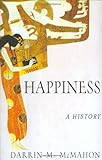
Author: Darrin M. McMahon  
Title: Happiness: A History 
Publisher: Atlantic Monthly PressDate: Copyright 2006 by Darrin M. McMahon
Pages: 32-34

Happiness: A History
by Darrin M. McMahon by Atlantic Monthly Press
Hardcover
If you wish to read further: Buy Now