
This reading of Paradiso 18 has 5 parts:
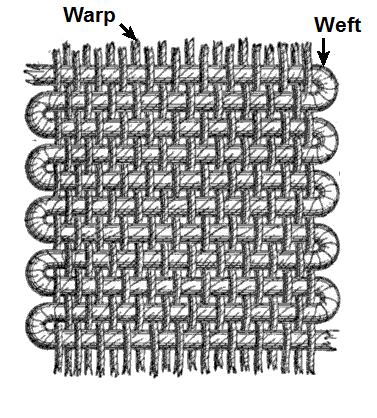
At the very moment in Paradiso 17 that the poet has finished listening to Cacciaguida's foretelling of his future, and immediately preceding the advice the old man will give him about the poem he'll go on to write, we have the image of weaving:
Poi che, tacendo, si mostrò spedita
l'anima santa di metter la trama
in quella tela ch'io le porsi ordita,
When by its silence showed that sainted soulThe image is of a tela - a web, or textile, which serves as the metaphor for the text they both are weaving. The poet puts down the warp (ordita), the old man provides the woof, or weft (trama).
That it had finished putting in the woof
Into that web which I had given it warped, (17.100-102)
Make manifest thy vision utterly,At this key moment of the canticle, we might assume that with these marching orders, the poet needed no further resolve to complete the poem, the very reason he was shown, in fact,
And let them scratch wherever is the itch.
within these wheels,
Upon the mount and in the dolorous valley,
Only the souls that unto fame are known.
So it's all the more surprising when, at the opening of the next canto (18) we hear the poet, still on Mars, still tasting his great great grandfather's bittersweet word (verbo), now speak openly of abandoning his task:
To further complicate things, the guide whom he turns to -- "the Lady who to God was leading me" -- mirrors such love and beauty that he is entranced to the point of seduction:
Not only that my language I distrust,
But that my mind cannot return so far
Above itself, unless another guide it.
non perch' io pur del mio parlar diffidi,Not only is Dante, like Theseus, helpless here to find his way back to memory without an Ariadne, he's also diffident about his parlar - his speaking. For one whose mission is to bring back his journey, a guide is on hand -- but for a poet to lack trust in his own speaking, this sounds like a crisis of faith.
ma per la mente che non può redire
sovra sé tanto, s'altri non la guidi. (18.10-12)
To further complicate things, the guide whom he turns to -- "the Lady who to God was leading me" -- mirrors such love and beauty that he is entranced to the point of seduction:
her again beholding, my affection
From every other longing was released.
While the eternal pleasure, which direct
Rayed upon Beatrice, from her fair face
Contented me with its reflected (secondo) aspect,
rimirando lei, lo mio affetto
libero fu da ogne altro disire,
fin che 'l piacere etterno, che diretto
raggiava in Bëatrice, dal bel viso
mi contentava col secondo aspetto.
Beatrice, the guide and symbol whose precise mission is to lead the pilgrim beyond himself, comes perilously close here to turning into the obstacle -- a Siren, Calypso, or Ariadne -- who threatens to waylay the hero, freeing him from desire to go beyond her.
Quite a predicament: a poet whose mastery of his own speech is uncertain; who, even if he felt secure, would yet be unable to remember what to say unless he has a guide; a guide who in this case happens to be so inherently beautiful as almost to blot out anything beyond her luminous self. Indeed, Beatrice verges on the opposite of a translucent symbol, teetering on becoming an end in herself, a Medusa before whom the poet would seize up, speechless, and end his odyssey right here.
 This is not at all what canto 17 set us up for. At the same time, despite the clear details that would render some poets entirely aphasic -- the segmented self lacking confidence in his ability to be at one with speech and memory, entranced by a secondo who's so perfect her smile could persuade us she's the primo -- the text does not exhibit anything like the shattering doubt and anxiety found in Inferno 9, when the Furies called on Medusa to end the poet's progress then and there, once and for all.
All the threats a poet might fear are in play here, but Beatrice is no Siren. Instead of holding him captive, she directs Dante to look away from the very thing he just said he could not do without -- herself:
Beatrice's direction is the opposite of what Virgil instructed him to do before Dis:
The poet is openly coming to grips with the challenges to his power over his medium. Now that he's been given the warp and weft of his place in history, his future, and his mission as artist, it's as if he needs more than ever to make sure that he, as poet, can finish the job. He needs confidence, guidance, faith, and courage. In another post we'll see how the rest of canto 18 speaks to these literally literary matters.
Quite a predicament: a poet whose mastery of his own speech is uncertain; who, even if he felt secure, would yet be unable to remember what to say unless he has a guide; a guide who in this case happens to be so inherently beautiful as almost to blot out anything beyond her luminous self. Indeed, Beatrice verges on the opposite of a translucent symbol, teetering on becoming an end in herself, a Medusa before whom the poet would seize up, speechless, and end his odyssey right here.

All the threats a poet might fear are in play here, but Beatrice is no Siren. Instead of holding him captive, she directs Dante to look away from the very thing he just said he could not do without -- herself:
Conquering me with the radiance of a smile,
She said to me, "Turn thee about and listen;
Not in mine eyes alone is Paradise."
Vincendo me col lume d'un sorriso,Non pur ne'miei occhi, says Beatrice. "Not in my eyes alone." If the poet were not who he is, we might hear him say, "Not a problem - you're paradisal enough for me."
ella mi disse: “Volgiti e ascolta;
ché non pur ne' miei occhi è paradiso.”
Beatrice's direction is the opposite of what Virgil instructed him to do before Dis:
"Turn thyself round [i.e., away from Medusa], and keep thine eyes close shut,"
“Volgiti 'n dietro e tien lo viso chiuso;"Here in Paradise, as Beatrice directed, he turns away from her, and sees Cacciaguida do something unprecedented in the poem: The old man speaks a name, and the hero so named shoots across the radius of the giant cross on the red planet. Words assume power, speech and act are one.
né mi fu noto il dir prima che 'l fatto.For a poet struggling with his own power over his art, this would be a powerful thing to witness. The poet's last word about Cacciaguida -- who is singing, his face lit up with his soul's fervor -- is "artista."
nor noted I the word before the deed.
The poet is openly coming to grips with the challenges to his power over his medium. Now that he's been given the warp and weft of his place in history, his future, and his mission as artist, it's as if he needs more than ever to make sure that he, as poet, can finish the job. He needs confidence, guidance, faith, and courage. In another post we'll see how the rest of canto 18 speaks to these literally literary matters.


