

Reading classical works aloud in Sarasota, and talking about them.
Wednesday, March 21, 2007

Tuesday, March 13, 2007
Canto 19: Geomancy
Just before the pilgrim has his second dream, he offers a time indication via a reference to geomancy - the ancient art of using figures to tell the future. He refers specifically to the figure of fortuna maior, seen below, second row down, left hand side:

More on astrological geomancy can be found here.

More on astrological geomancy can be found here.
Sunday, March 11, 2007
Canto 18: Caesar pauses to destroy Marseilles
One of the more unusual pairings of Biblical and Classical exemplars comes in Canto 18, where we first are reminded of how Mary, after learning she was to be the mother of God, made haste to visit Elizabeth in the hill country, who was also pregnant (with John the Baptist). We are then treated to a scene from Lucan's Pharsalia where Caesar chooses to attack Marseilles, (here rendered as Massilia). Although in great haste to attack Spain, Caesar pauses at Marseilles long enough to destroy a sacred grove, set up the attack structures, and order his army to persist until the city falls. Impatient with the long siege, he then races off to Spain.
Here's part of the set-up for the scene:
Here's part of the set-up for the scene:
But Caesar's visage stern betrayed his ire
Which thus broke forth in words: "Vain is the hope
Ye rest upon my march: speed though I may
Towards my western goal, time still remains
To blot Massilia out. Rejoice, my troops!
Unsought the war ye longed for meets you now:
The fates concede it. As the tempests lose
Their strength by sturdy forests unopposed,
And as the fire that finds no fuel dies,
Even so to find no foe is Caesar's ill.
When those who may be conquered will not fight
That is defeat. Degenerate, disarmed
Their gates admit me! Not content, forsooth,
With shutting Caesar out they shut him in!
They shun the taint of war! Such prayer for peace
Brings with it chastisement. In Caesar's age
Learn that not peace, but war within his ranks
Alone can make you safe." Lucan Bk III
Tuesday, March 06, 2007
Dore and Dante

This is Gustave Dore's version of the encounter with Marco Lombardo in Canto 16. Numerous scenes from the Commedia as reimagined by Dore can be found here.
Sunday, March 04, 2007
Another tale of Satan's Fall
Louis Ginzberg, a 20th century Talmudic scholar, gathered many traditional Jewish folktales and legends into a four-volume series of narratives entitled Legends of the Jews, which is online here. Eunice points us to the legend of Satan's fall:
THE FALL OF SATAN
from
Legends of the Jews
by Louis Ginzberg
The extraordinary qualities with which Adam was blessed, physical and spiritual as well, aroused the envy of the angels. They attempted to consume him with fire, and he would have perished, had not the protecting hand of God rested upon him, and established peace between him and the heavenly host. In particular, Satan was jealous of the first man, and his evil thoughts finally led to his fall.
After Adam had been endowed with a soul, God invited all the angels to come and pay him reverence and homage. Satan, the greatest of the angels in heaven, with twelve wings, instead of six like all the others, refused to pay heed to the behest of God, saying, "Thou didst create us angels from the splendor of the Shekinah, and now Thou dost command us to cast ourselves down before the creature which Thou didst fashion out of the dust of the ground!" God answered, "Yet this dust of the ground has more wisdom and understanding than thou." Satan demanded a trial of wit with Adam, and God assented thereto, saying: "I have created beasts, birds, and reptiles, I shall have them all come before thee and before Adam. If thou art able to give them names, I shall command Adam to show honor unto thee, and thou shalt rest next to the Shekinah of My glory. But if not, and Adam calls them by the names I have assigned to them, then thou wilt be subject to Adam, and he shall have a place in My garden, and cultivate it." Thus spake God, and He betook Himself to Paradise, Satan following Him.
When Adam beheld God, he said to his wife, "O come, let us worship and bow down; let us kneel before the Lord our Maker." Now Satan attempted to assign names to the animals. He failed with the first two that presented themselves, the ox and the cow. God led two others before him, the camel and the donkey, with the same result. Then God turned to Adam, and questioned him regarding the names of the same animals, framing His questions in such wise that the first letter of the first word was the same as the first letter of the name of the animal standing before him. Thus Adam divined the proper name, and Satan was forced to acknowledge the superiority of the first man.
Nevertheless he broke out in wild outcries that reached the heavens, and he refused to do homage unto Adam as he had been bidden. The host of angels led by him did likewise, in spite of the urgent representations of Michael, who was the first to prostrate himself before Adam in order to show a good example to the other angels. Michael addressed Satan: "Give adoration to the image of God! But if thou doest it not, then the Lord God will break out in wrath against thee." Satan replied: "If He breaks out in wrath against me, I will exalt my throne above the stars of God, I will be like the Most High! "At once God flung Satan and his host out of heaven, down to the earth, and from that moment dates the enmity between Satan and man.'
Wednesday, February 28, 2007
Sourcing the War in Heaven

For the question of the War in Heaven, the fall of Satan and his later career, Jutta suggests this article from the Catholic Encyclopedia, which is pretty comprehensive, and has hyperlinks to several other related topics. A few snippets:
Despite numerous references to Satan in the Old Testament, the encyclopedia notes,Mention is made of the Devil in many passages of the Old and New Testaments, but there is no full account given in any one place, and the Scripture teaching on this topic can only be ascertained by combining a number of scattered notices from Genesis to Apocalypse, and reading them in the light of patristic and theological tradition. The authoritative teaching of the Church on this topic is set forth in the decrees of the Fourth Lateran Council (cap. i, "Firmiter credimus"), wherein, after saying that God in the beginning had created together two creatures, the spiritual and the corporeal, that is to say the angelic and the earthly, and lastly man, who was made of both spirit and body, the council continues:
"Diabolus enim et alii dæmones a Deo quidem naturâ creati sunt boni, sed ipsi per se facti sunt mali." ("the Devil and the other demons were created by God good in their nature but they by themselves have made themselves evil.")Here it is clearly taught that the Devil and the other demons are spiritual or angelic creatures created by God in a state of innocence, and that they became evil by their own act.
it is remarkable that for an account of the fall of the angels we must turn to the last book of the Bible.The sole Biblical official account of the war in Heaven, which presumably preceded the Creation we read of in Genesis, is found in the last book of the New Testament.
On the question of when the fall of Satan occurred, we find this:
As might be expected from the attention they had bestowed on the question of the intellectual powers of the angels, the medieval theologians had much to say on the time of their probation. The angelic mind was conceived of as acting instantaneously, not, like the mind of man, passing by discursive reasoning from premises to conclusions. It was pure intelligence as distinguished from reason. Hence it would seem that there was no need of any extended trial....To modern readers the notion that the sin was committed in the second instant of creation may seem scarcely less incredible than the possibility of a fall in the very first. But this may be partly due to the fact that we are really thinking of human modes of knowledge, and fail to take into account the Scholastic conception of angelic cognition. For a being who was capable of seeing many things at once, a single instant might be equivalent to the longer period needed by slowly-moving mortals.There's a good deal more there. And more images of Michael here.
Monday, February 26, 2007
A pattern at the center of Purgatorio
It seems that Cantos 14 through 20 contain another architectonic pattern that remained unnoticed for centuries, until Charles Singleton pointed to it in 1965: The symmetrical canto lengths surrounding Canto 17 give us a structural basis for calling that canto the center of the entire Commedia. (This makes more sense if Canto I of the Inferno is viewed as a prologue to the entire poem, i.e., 1 + 33 + 33 + 33 = 100.)
This pattern involves a mirroring of numbers of lines around the center:
Canto 14: 151 lines
There is an additional pair of "pendants" involving the phrase "libero arbitrio" in cantos 16 and 18.
It wasn't until the 20th century that scholars began to analyze the ring structure in Homer's Iliad - yet Dante seems to have created his own "mini-ring" in his epic without having access either to Homer or their scholarship.
This pattern involves a mirroring of numbers of lines around the center:
Canto 14: 151 lines
Canto 15: 145 linesCanto 20: 151 lines
Canto 16: 145 linesCanto 17: 139 linesCanto 18: 145 lines
Canto 19: 145 lines
There is an additional pair of "pendants" involving the phrase "libero arbitrio" in cantos 16 and 18.
It wasn't until the 20th century that scholars began to analyze the ring structure in Homer's Iliad - yet Dante seems to have created his own "mini-ring" in his epic without having access either to Homer or their scholarship.
Monday, February 19, 2007
The Darkness and the Light
Enlightenment is man's emergence from his self-imposed tutelage. Tutelage is the inability to use one's own understanding without another's guidance. This tutelage is self-imposed if its cause lies not in lack of understanding but in indecision and lack of courage to use one's own mind without another's guidance. Dare to know! Have the courage to use one's own understanding! is therefore the motto of the Enlightenment ... If it is only given freedom, enlightenment is inevitable... I. Kant, Political Writings, trans. H.B. Nisbet.Writing toward the end of the 18th century, Kant sounded the clarion of the ascent of Reason -- the eager anticipation of the emancipation of the mind, which, once free, would rely upon itself to progress toward universal knowledge.
What would Dante make of this bold exodus from guides, tutors, teachers?
Here's Marco Lombardo inside the absolute darkness of Canto 16:
Frate,
lo mondo e cieco, e tu vien ben da lui
Brother,
the world is blind, and indeed you come from it.
Tuesday, February 13, 2007
Purgatorio 16: Marco Lombardo

Giotto: Wrath
Dante interlaces several heterogeneous elements in this canto, not all of them in any obvious way linked to wrath. To name only a few:
- The intense darkness of the fummo, the acrid smoke that envelopes the entire canto;
- The theme of free will introduced by Marco Lombardo in response to Dante's questioning of the origin of evil;
- The free are subject to a higher nature that creates the human mind;
- Multiple metaphors of knots tied and loosed;
- The joy of the creator;
- The innocent new soul, that "knows nothing" -- sa nulla -- other than what pleases;
- The necessity for a guide, law;
- The Two Suns of Pope and Emperor - the relation of religion and state;
- The three men through whose nobility "the old times reprove the new"
Purgatorio 15: Three moments of blindness
Three times in canto 15, Dante loses his power of sight: with the angel, during the "visione estatica," and in the thick enveloping smoke at the end. All this during the setting of the sun. The play of blindness and vision will continue through the next cantos, which are at the literal center of the Commedia.
Monday, February 12, 2007
Badiou on "evil"
Alain Badiou, a contemporary French thinker, offers this comment about how the concept of "evil" is handled in politics and media today:
In truth, our leaders and propagandists know very well that liberal capitalism is an inegalitarian regime, unjust, and unacceptable for the vast majority of humanity. And they know too that our "democracy" is an illusion: Where is the power of the people? Where is the political power for third world peasants, the European working class, the poor everywhere? We live in a contradiction: a brutal state of affairs, profoundly inegalitarian-where all existence is evaluated in terms of money alone-is presented to us as ideal. To justify their conservatism, the partisans of the established order cannot really call it ideal or wonderful. So instead, they have decided to say that all the rest is horrible. Sure, they say, we may not live in a condition of perfect Goodness. But we're lucky that we don't live in a condition of Evil. Our democracy is not perfect. But it's better than the bloody dictatorships....That's why the idea of Evil has become essential. No intellectual will actually defend the brutal power of money and the accompanying political disdain for the disenfranchised, or for manual laborers, but many agree to say that real Evil is elsewhere. Who indeed today would defend the Stalinist terror, the African genocides, the Latin American torturers? Nobody. It's there that the consensus concerning Evil is decisive. Under the pretext of not accepting Evil, we end up making believe that we have, if not the Good, at least the best possible state of affairs-even if this best is not so great.It might be worth thinking about how this characterization of a view of evil compares -- or contrasts -- with what Purgatorio presents. Do we see the kind of demonizing of Evil in Dante that Badiou finds in certain present-day political rhetoric?
Thursday, February 01, 2007
David and Solomon: Hicks from the Sticks?
The headline might be something of an exaggeration, but according to new archaeological research reviewed in Science Magazine, not as much as you might think.
Israeli archaeologist Israel Finkelstein has published controversial studies suggesting that the storied realm of the mighty kings of united Israel of which we read might have been more story than actuality: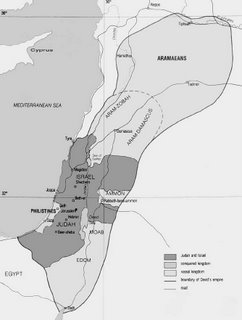
In The Bible Unearthed, Finkelstein and Neil Asher Silberman document the state of the evidence for the glories of the United Kingdom, and find more fable than fact:
Israeli archaeologist Israel Finkelstein has published controversial studies suggesting that the storied realm of the mighty kings of united Israel of which we read might have been more story than actuality:
The Bible tells of the golden age of the united kingdom of Israel ruled over by a Judean monarch, first David and then his son Solomon. It describes a renowned empire spreading from the Red Sea to the border of Syria, the splendor of Jerusalem and the first Temple built by Solomon, as well as other magnificent building projects. This united kingdom then split into Israel in the north and Judah in the south. Does archeology confirm this picture? Despite legendary exaggerations and elaborations, the authors believe that David and Solomon did exist -- but as minor highland chieftains ruling a population of perhaps 5,000 people.

In The Bible Unearthed, Finkelstein and Neil Asher Silberman document the state of the evidence for the glories of the United Kingdom, and find more fable than fact:
There is no trace of written documents or inscriptions, nor of the Temple or palace of Solomon, and buildings once identified with Solomon have been shown to date from other periods. Current evidence refutes the existence of a unified kingdom: "The glorious epic of united monarchy was -- like the stories of the patriarchs and the sagas of the Exodus and conquest -- a brilliant composition that wove together ancient heroic tales and legends into a coherent and persuasive prophecy for the people of Israel in the seventh century BCE." Larger map and more here.
Subscribe to:
Posts (Atom)

