
Paradiso 17 has a centrality that makes itself apparent on several registers. It's the literal center of the canticle, and it's also a moment when, through dialog with Cacciaguida, the poet recapitulates the journey he has taken, and confronts his "root." That radice turns out to be the source of the pilgrim's historical existence as well as the figure that articulates the poem's rhetorical mode.
The journey of the pilgrim is recapped at least three times in the canto. The first is here:
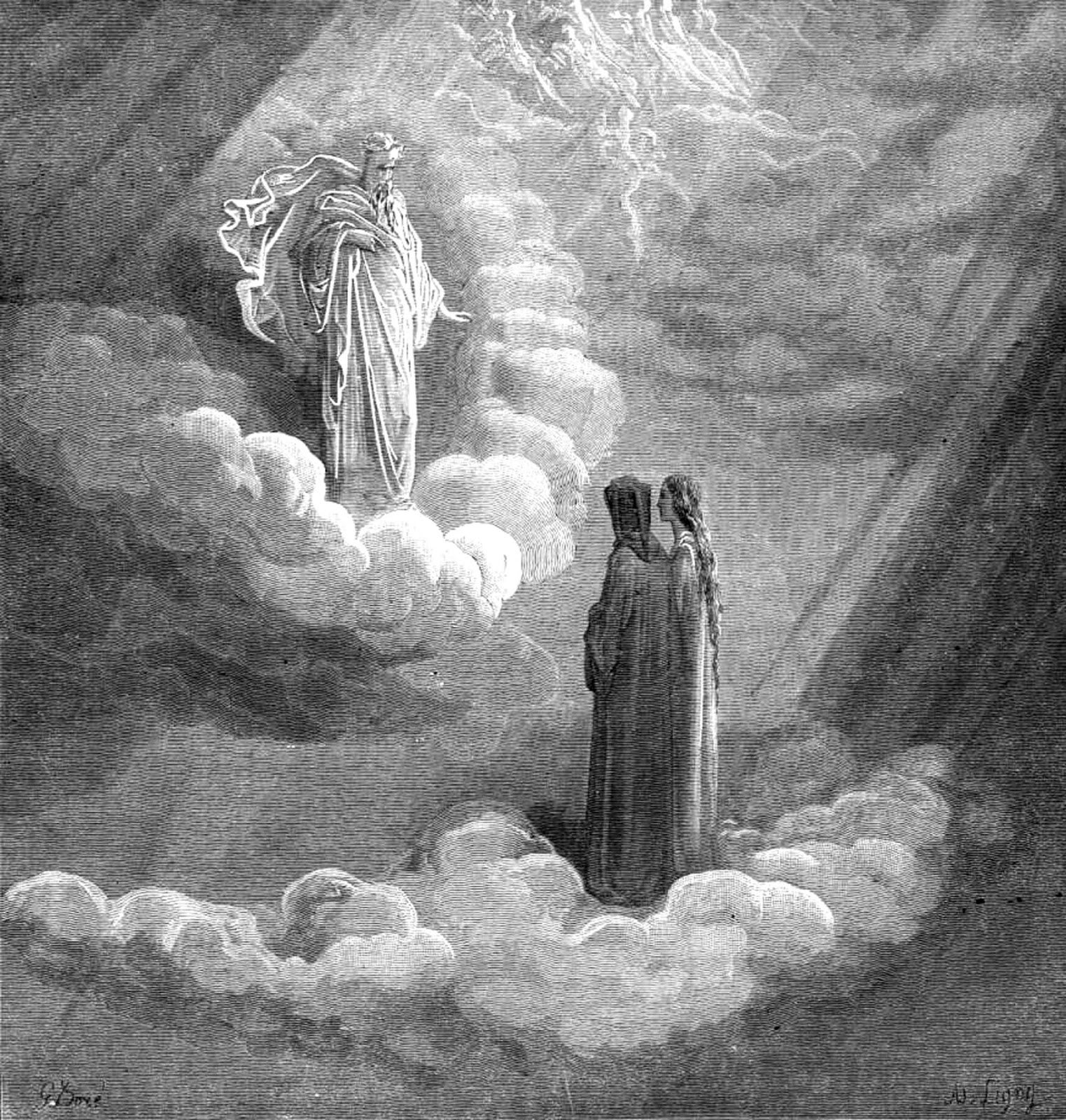
 This reconnoitering -- a looking back to the selva oscura and Cacciaguida's looking back to his life in Florence -- brings the pilgrim and the poet into a kind of convergence. It might not be "random" that Dante's first words to his ancestor in this canto had to do with how triangles cannot have two obtuse angles (17:15), for here Poet and Pilgrim, in conversation with Cacciaguida, undergo a kind of triangulated turn as Cacciaguida explains why this pilgrim's story has to be told through the faces, voices, and fates of people known to fame:
The appearance of the root of Dante puts Dante in his place, as a specific human in historical time. It comes shortly before Dante will be displaced, exiled from his city -- a foreknowledge that the pilgrim also gains from this encounter.
For the poem to be read and understood, says Cacciaguida, it must speak of public figures, some of whom were still alive, or recently deceased (like Pope Boniface) even as it was composed. Although the poet is concerned that writing about certain people could have real consequences -- as some of these folks had power to make him unwelcome throughout Italy -- Dante understands that his poem will fail unless his readers see and hear these historical characters.
In other words, the poet has to speak of figures like Francesca, Farinata, Cavalcante, Ugolino, Manfred, La Pia, Charles Martel, and so many others as if they were not poetic figures, which in fact is exactly what they are.
We might look at it this way: if I tell you that you can believe something I tell you because so-and-so told it to me, and you know him, you might well be persuaded. But now, suppose you learn that I made up the tale of meeting so and so, and his telling me such and such, because that was the only way I could get you to believe me?
Cacciaguida's manifesto marks the pilgrim's encounters with actual famed personages as the lie necessary to the poem's rhetorical power -- a power which depends upon a reciprocally empowering relation of pilgrim and poet that is also also mutually exclusive.
Poet and Pilgrim are inextricably bound together - neither can exist without the other, yet each exists only by means of a sacrificial obliteration of the other. This impossible double figure, this mutually annihilating "author," turns out to be the necessary lie fecund enough, as root, to produce this poem. Looked at another way, the poem is rooted in an illogical act of courage that puts forth something that ought by all "knowledge" never to have been possible.
The path of the journey, in this light, must be reconnoitered, and so must be the mode of its speaking. No longer is the story of meeting x, then, y, simply reflected or re-presented by the poem. Rather the truth intent of the poem requires that the poet create and use these figures as if he had extracted them as examples (per essempro*) from his experiences.
Representation here is usurped by another poetic order:
The journey of the pilgrim is recapped at least three times in the canto. The first is here:
mentre ch'io era a Virgilio congiunto
su per lo monte che l'anime cura
e discendendo nel mondo defunto,
dette mi fuor di mia vita futura
parole gravi, (17:19-23)
While I was with Virgilius conjoined
Upon the mountain that the souls doth heal,
And when descending into the dead world,
Were spoken to me of my future life
Some grievous words;
Then [he] made reply: "A conscience overcast
Or with its own or with another's shame,
Will taste forsooth the tartness of thy word;
But ne'ertheless, all falsehood [menzogna] laid aside,
Make manifest thy vision utterly,
And let them scratch wherever is the itch;
For if thine utterance shall offensive be
At the first taste, a vital nutriment
'Twill leave thereafter, when it is digested.
This cry of thine shall do as doth the wind,
Which smiteth most the most exalted summits,
And that is no slight argument of honour.
Therefore are shown to thee within these wheels,
Upon the mount and in the dolorous valley,
Only the souls that unto fame are known;
To "make manifest" is to display by action the nature of a thing. To speak of his experience in a way that can be understood by those who hear his poem, the poet must offer the sort of example whose root (radice) is not hidden. This is spoken by the figure who calls himself "your root." Cacciaguida is at the base of a family tree that, planted in Florence, grew through time until it put forth a fronda -- a leaf or branch -- named "Dante."Because the spirit of the hearer rests not,
Nor doth confirm its faith by an example
Which has the root of it unknown and hidden,
Or other reason that is not apparent." 17:124-142
The appearance of the root of Dante puts Dante in his place, as a specific human in historical time. It comes shortly before Dante will be displaced, exiled from his city -- a foreknowledge that the pilgrim also gains from this encounter.
For the poem to be read and understood, says Cacciaguida, it must speak of public figures, some of whom were still alive, or recently deceased (like Pope Boniface) even as it was composed. Although the poet is concerned that writing about certain people could have real consequences -- as some of these folks had power to make him unwelcome throughout Italy -- Dante understands that his poem will fail unless his readers see and hear these historical characters.
In other words, the poet has to speak of figures like Francesca, Farinata, Cavalcante, Ugolino, Manfred, La Pia, Charles Martel, and so many others as if they were not poetic figures, which in fact is exactly what they are.
We might look at it this way: if I tell you that you can believe something I tell you because so-and-so told it to me, and you know him, you might well be persuaded. But now, suppose you learn that I made up the tale of meeting so and so, and his telling me such and such, because that was the only way I could get you to believe me?
Cacciaguida's manifesto marks the pilgrim's encounters with actual famed personages as the lie necessary to the poem's rhetorical power -- a power which depends upon a reciprocally empowering relation of pilgrim and poet that is also also mutually exclusive.
Poet and Pilgrim are inextricably bound together - neither can exist without the other, yet each exists only by means of a sacrificial obliteration of the other. This impossible double figure, this mutually annihilating "author," turns out to be the necessary lie fecund enough, as root, to produce this poem. Looked at another way, the poem is rooted in an illogical act of courage that puts forth something that ought by all "knowledge" never to have been possible.
The path of the journey, in this light, must be reconnoitered, and so must be the mode of its speaking. No longer is the story of meeting x, then, y, simply reflected or re-presented by the poem. Rather the truth intent of the poem requires that the poet create and use these figures as if he had extracted them as examples (per essempro*) from his experiences.
Representation here is usurped by another poetic order:
"Because the spirit of the hearer rests not,
Nor doth confirm its faith by an example
Which has the root of it unknown and hidden,
Or other reason that is not apparent."
"che l'animo di quel ch'ode, non posa
né ferma fede per essempro ch'aia
la sua radice incognita e ascosa,
né per altro argomento che non paia.”
Instead of the poem being read as the realistic reflection of the pilgrim's experience, that "experience" is revealed as device -- the poet's rhetorical tool necessitated by, and geared to, the mode of the Commedia, which can be called allegory.
The pilgrim and the poet, no longer separable, converge in Cacciaguida's manifesto. Only, we have to be quite clear: Like Cacciaguida's smile, the poem's persuasive power as representation requires it to conceal its poetic strategy. To persuade, it must seem to represent the pilgrim's encounters with famed historical figures as historical narrative, and to conceal the menzogna that it is not poetic artifice, which at every moment it most certainly is.
Pilgrim and poet fuse here, but they do so precisely as does a triangle with two obtuse angles. The fusion occurs at a point outside the system of the text -- the system which it alone brought into being. The "point" is made in Cacciaguida's dark, luminous manifesto of the rhetorical model -- the courageous speech act -- of the Commedia itself.


The pilgrim and the poet, no longer separable, converge in Cacciaguida's manifesto. Only, we have to be quite clear: Like Cacciaguida's smile, the poem's persuasive power as representation requires it to conceal its poetic strategy. To persuade, it must seem to represent the pilgrim's encounters with famed historical figures as historical narrative, and to conceal the menzogna that it is not poetic artifice, which at every moment it most certainly is.
Pilgrim and poet fuse here, but they do so precisely as does a triangle with two obtuse angles. The fusion occurs at a point outside the system of the text -- the system which it alone brought into being. The "point" is made in Cacciaguida's dark, luminous manifesto of the rhetorical model -- the courageous speech act -- of the Commedia itself.
*The root sense of essempro is traced to an act of drawing something forth - i.e., we "make an example" because an example is not just a passive reflection, but an act of rhetorical persuasion.


