Thus in truth the Comedy is a picture of earthly life. The human world in all its breadth and depth is gathered into the structure of the hereafter and there it stands: complete, unfalsified, yet encompassed in an eternal order; the confusion of earthly affairs is not concealed or attenuated or immaterialized, but preserved in full evidence and grounded in a plan which embraces it and raises it above all contingency. Doctrine and fantasy, history and myth are woven into an almost inextricable skein....Once one has succeeded in surveying the whole, the hundred cantos, with their radiant terza rima, their perpetual binding and loosing, reveal the dreamlike lightness and remoteness of a perfection that seems to hover over us like a dance of unearthly figures.

Reading classical works aloud in Sarasota, and talking about them.
Tuesday, January 30, 2007
Auerbach on the Commedia

Monday, January 29, 2007
Ovidian Envy
Here is Ovid's portrait of Envy, taken from the story of Aglauros in Book II of the Metamorphoses. Pallas Athena has gone to Envy's cave to command Envy to poison Aglauros:
Envy could be seen, eating vipers’ meat that fed her venom, and at the sight the goddess averted her eyes. But the other got up slowly from the ground, leaving the half-eaten snake flesh, and came forward with sluggish steps. When she saw the goddess dressed in her armour and her beauty, she moaned and frowned as she sighed. Pallor spreads over her face, and all her body shrivels.
Her sight is skewed, her teeth are livid with decay, her breast is green with bile, and her tongue is suffused with venom. She only smiles at the sight of suffering. She never sleeps, excited by watchful cares. She finds men’s successes disagreeable, and pines away at the sight. She gnaws and being gnawed is also her own punishment. Though she hated her so, nevertheless Tritonia spoke briefly to her. ‘Poison one of Cecrops’s daughters with your venom. That is the task. Aglauros is the one.’Without more words she fled and with a thrust of her spear sprang from the earth.
Envy, squinting at her as she flees, gives out low mutterings, sorry to think of Minerva’s coming success. She takes her staff bound with strands of briar, and sets out, shrouded in gloomy clouds. Wherever she passes she tramples the flower-filled fields, withers the grass, blasts the highest treetops and poisons homes, cities and peoples with her breath. At last she sees Athens, Tritonia’s city, flourishing with arts and riches and leisured peace. She can hardly hold back her tears because she sees nothing tearful.
Sunday, January 28, 2007
Athens 1941
The World War II experiences of Dr. Peter Gram of our group have been featured in an interview with the local paper. He's also written about them in his book, Memoirs of Greece: The Years of the Nazi Occupation (1941-1944), Congratulations Peter!
Wednesday, January 24, 2007
A few of the Seven Deadlies Illustrated
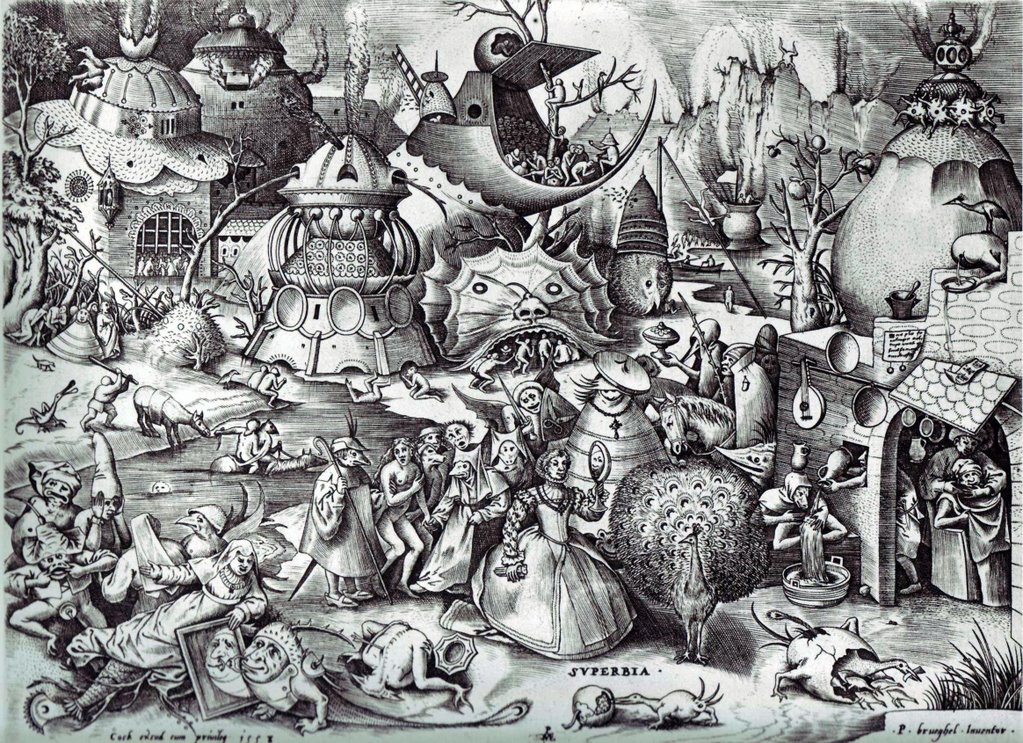

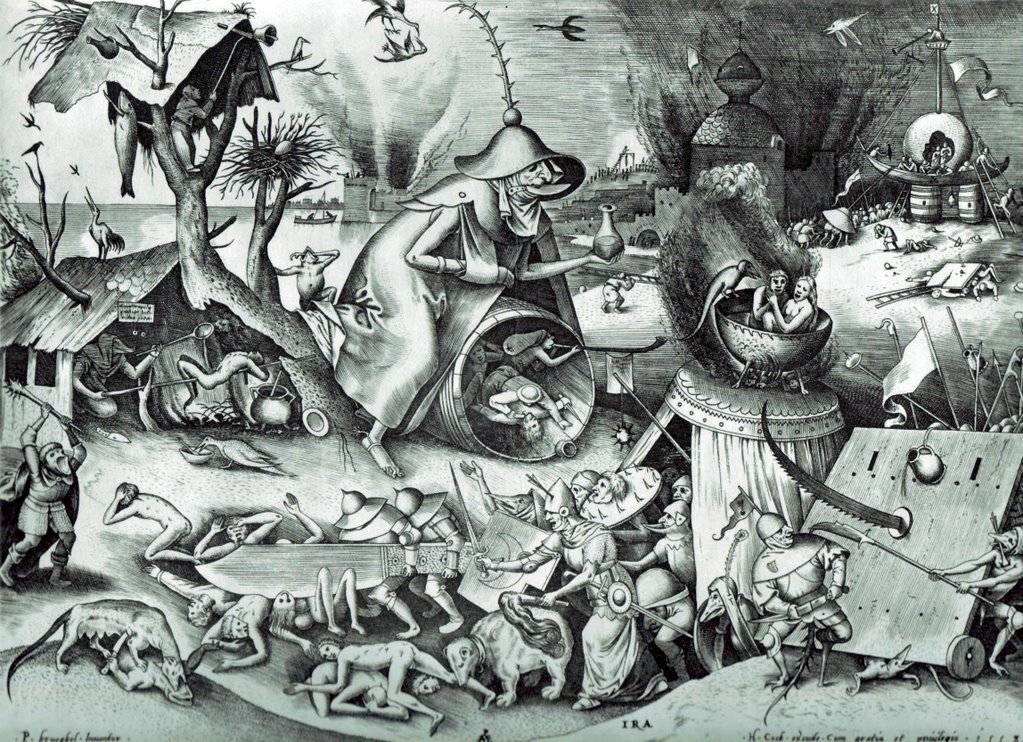
Monday, January 22, 2007
Augustine on Envy

Now these brothers, Cain and Abel, were not both animated by the same earthly desires, nor did the murderer envy the other because he feared that, by both ruling, his own dominion would be curtailed -- for Abel was not solicitous to rule in that city which his brother built -- he was moved by that diabolical, envious hatred with which the evil regard the good, for no other reason than because they are good while themselves are evil. For the possession of goodness is by no means diminished by being shared with a partner either permanent or temporarily assumed; on the contrary, the possession of goodness is increased in proportion to the concord and charity of each of those who share it. In short, he who is unwilling to share this possession cannot have it; and he who is most willing to admit others to a share of it will have the greatest abundance to himself. The quarrel, then, between Romulus and Remus shows how the earthly city is divided against itself; that which fell out between Cain and Abel illustrated the hatred that subsists between the two cities, that of God and that of men. City of God XV.5
Sunday, January 21, 2007
Purgatorio 14
If time allows, after reading Purgatorio 14, pay another visit to Inferno 13 -- you might find some fascinating echoes, parallels, differences.
Also: Much to explore in this canto - what do you make of the examples of envy - only two are given - in lines 133-141. Cain and Aglauros arrive with the sound of thunder:
Finally, remember that we meet in North Library on Wednesday, 10:15 a.m.
Also: Much to explore in this canto - what do you make of the examples of envy - only two are given - in lines 133-141. Cain and Aglauros arrive with the sound of thunder:
Poi fummo fatti soli procedendo,
folgore parve quando l'aere fende,
voce che giunse di contra dicendo:
'Anciderammi qualunque m'apprende';
e fuggì come tuon che si dilegua,
se sùbito la nuvola scoscende.
Come da lei l'udir nostro ebbe triegua,
ed ecco l'altra con sì gran fracasso,
che somigliò tonar che tosto segua:
«Io sono Aglauro che divenni sasso»;
e allor, per ristrignermi al poeta,
in destro feci, e non innanzi, il passo.
Finally, remember that we meet in North Library on Wednesday, 10:15 a.m.
Friday, January 19, 2007
From the horse's mouth
"What we're seeing is the top 1% struggling to keep up with the top 1/10th of 1%," he adds. "And those people trying to keep up with the top 1/100th of 1%. There is a drive by the merely rich to keep up with the obscenely rich." Dalton Conley, a sociologist at New York University who studies status (Wall St. Journal - subscription req'd.)
Thursday, January 18, 2007
Purgatorio 13: A few notes
There are notable differences in medium and spatial orientation, among others, between the Terrace of Envy and that of Pride.
First off, where the Terrace of Pride had white bas-reliefs and a marble path of divinely wrought images, the first glimpse of Envy's domain is of a bleak, livid space with no one in sight.
The words occhi (eyes) and videre (seeing, sight) appear numerous times in this canto, but what's striking is what is not seen - the invisibile parlare, we might call it, of the voices that rush past Dante and Virgil as they approach the band of sinners.
Why are the eyes of the envious sealed "like hawks"?
Why, when Dante asks if one of them is Italian, is he told that all are "citizens of one true city"? Why does the theme of the City of God, versus the City of Man, surface here amid the envious?
Singleton notes yet another element of Dante's realism: La Sapia knows Dante is alive because, with the extra sensitivity of the blind, she hears him breathing, while she and the others have no idea of Virgil's presence.
La Sapia is overjoyed at the defeat of her fellow citizens in the battle of Colle, some of which she might have seen from her husband's castle. It was this battle in which Provenzan Salvani, met on the previous terrace, was killed.
First off, where the Terrace of Pride had white bas-reliefs and a marble path of divinely wrought images, the first glimpse of Envy's domain is of a bleak, livid space with no one in sight.
The words occhi (eyes) and videre (seeing, sight) appear numerous times in this canto, but what's striking is what is not seen - the invisibile parlare, we might call it, of the voices that rush past Dante and Virgil as they approach the band of sinners.
Why are the eyes of the envious sealed "like hawks"?
Why, when Dante asks if one of them is Italian, is he told that all are "citizens of one true city"? Why does the theme of the City of God, versus the City of Man, surface here amid the envious?
Singleton notes yet another element of Dante's realism: La Sapia knows Dante is alive because, with the extra sensitivity of the blind, she hears him breathing, while she and the others have no idea of Virgil's presence.
La Sapia is overjoyed at the defeat of her fellow citizens in the battle of Colle, some of which she might have seen from her husband's castle. It was this battle in which Provenzan Salvani, met on the previous terrace, was killed.
Monday, January 08, 2007
A couple of quick reminders
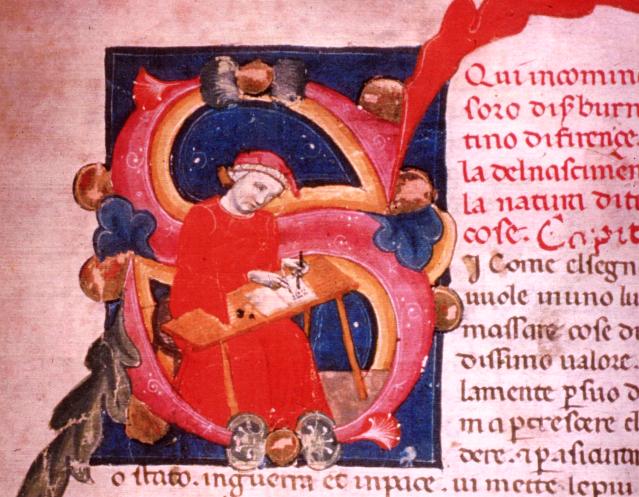
Do remember we are now meeting at the North Library, beginning this Wednesday. Also, just to recall a few notes here that were made a while back:
On Canto 11
On Canto 12
Wednesday, January 03, 2007
Canto 10: Worms and Butterflies

O superbi cristian, miseri lassi,
Che, de la vista de la mente infermi,
Fidanza avete ne’ retrosi passi,
Non v’accogete voi che noi siam vermi
Nati a formar l’angelica farfalla,
Che vola a la giustizia sanza schermi?
~~~
Che, de la vista de la mente infermi,
Fidanza avete ne’ retrosi passi,
Non v’accogete voi che noi siam vermi
Nati a formar l’angelica farfalla,
Che vola a la giustizia sanza schermi?
~~~
O Christians, arrogant, exhausted, wretched,
whose intellects are sick and cannot see
who place your faith in backward steps,
do you not know that we are worms and born
to form the angelic butterfly that soars,
without defenses, to confront His judgment?
(Purgatorio X. 121-26)
whose intellects are sick and cannot see
who place your faith in backward steps,
do you not know that we are worms and born
to form the angelic butterfly that soars,
without defenses, to confront His judgment?
(Purgatorio X. 121-26)
The paradoxical consciousness of the worm that "knows" it has another destiny, a destiny in which it is radically an other. What weight should we give to the difference between worms that become butterflies, as occurs in nature, and worms "born to form" an angelic butterfly?
Moral dilemma: If the worm forgets it is a worm, it inflates into a false consciousness of its true destiny: Pride. But if the worm forgets its ultimate and truest being, it commits to remaining a worm, demoralized and despairing.
This creature does not know how it goes from worm to butterfly. Does it require divine aid? Something beyond its -- our -- own nature?
What is suggested by the fact that this angelic butterfly flies up to Justice "without defenses"?
Sunday, December 31, 2006
Dante discussed in NYRB
Shaw emailed to point out an essay in the Jan. 11, 2007 New York Review of Books by Michael Dirda about Dante and Erich Auerbach's study of him entitled Dante: Poet of the Secular World.
According to Dirda,
Dante: Poet of the Secular World
By Erich Auerbach
Introduction by Michael Dirda
According to Dirda,
Auerbach makes the seemingly paradoxical claim that it is in the poetry of Dante, supreme among religious poets, that the secular world of the modern novel first took imaginative form. An inspiring introduction to one of world’s greatest poets and a brilliantly argued essay in the history of ideas.The full essay is available online for a fee, but Shaw has kindly offered to save the print version. A bit more about the book:
Dante: Poet of the Secular World
By Erich Auerbach
Introduction by Michael Dirda
Auerbach's study of Dante, a precursor and necessary complement to Mimesis, his magisterial overview of realism in Western literature, illuminates both the overall structure and the individual detail of Dante's work, showing it to be an extraordinary synthesis of the sensuous and the conceptual, the particular and the universal, that redefined notions of human character and fate and opened the way into modernity.Reviews
This is a book with all the freshness and excitement of new discovery. The excitement remains through all these years since it's writing. This account of Dante's poetry, from the moving springs of its style and the human presentness of its drama to the cosmic vision which produces and validates them both, an account based on history but shaped by a special sense of the issues, possesses a validity which no other book, past or present, can diminish.
— Theodore Silverstein, The University of Chicago
Auerbach offers the thought that for all its investment in the eternal and immutable, the Divine Comedy is even more successful in representing reality as basically human...The refinement of Auerbach's own writing about Dante is truly exhilarating to read, not just because of his complex, paradox-filled insights, but because of their Nietzschean audacity.
— Edward Said
Sunday, December 17, 2006
More on Virgil's Vision of Rome
A review of the Fagles translation of the Aeneid by Brad Leithouser which appeared in the Times - thanks Mussy!
Wars and a Man
There’s a moment in Virgil’s “Aeneid” when the Trojan forces are massed like “a cloudburst wiping out the sun, sweeping over the seas toward land.” It’s an image that evokes another army, likewise intimidating, although this one’s composed chiefly of sedentary men, white-haired and bespectacled. Their numbers, too, are unreckonable — those squadrons of scholars who have, over the centuries, translated the “Aeneid.”
Has any book been recast into English more times than this tale of Aeneas’ wanderings and the eventual establishment of the Roman Empire? Probably not, given both the poem’s venerability and the relative accessibility of Latin. When you further consider all the partial or complete versions in private manuscript — often the work of old classics teachers, shared with their students — we indeed confront something that looms over us like a cloudburst.
Robert Fagles, the poem’s newest translator, comes to the fray well armed. An emeritus professor of comparative literature at Princeton, he has already translated, with great success, Homer’s “Iliad” and “Odyssey.” And his publisher for the “Aeneid,” Viking, has accoutered him handsomely, with a clear map, a useful pronunciation glossary, and a harmonious blend of layout and type font and binding.
For all its translations, the “Aeneid” erects sizable obstacles for anybody hoping to render it into satisfying English. Perhaps the most formidable of these is the tale’s diminishing narrative drive. Most of what lingers in the reader’s memory — the fall of Troy, Dido’s passion and ultimate suicide, Aeneas’ journey to the Underworld — unfolds in the first six of the poem’s 12 books; the epic’s second half largely documents a successful military campaign against the Rutulians in Italy.
I’ve conducted a little poll over the years, asking various fellow English professors to name Aeneas’ chief adversary — the warrior Turnus, leader of the Rutulians, who stands in relation to Aeneas as Hector does to Achilles. They frequently can’t, which I find reassuring. For who can fault them, given that Turnus is, as epic antagonists go, so blandly magnificent? (Or is it magnificently bland?) He’s stalwart, handsome and, when left to his own devices, peaceable. If he’s occasionally possessed by blood-lust, this is mostly the gods’ doing. When we initially meet him, he’s sleeping heavily — until awakened by a messenger of revengeful Juno, who goads him into rage and carnage.
The “Aeneid” is suffused with a fascinating, upending sense that most of what goes gravely wrong on earth isn’t imputable to human agency. There’s something comforting to Virgil’s conception of humanity, in which relatively little malice and unreasonableness and rapacity seem innate to our kind. And there’s something unsettling as well — a vision of a world that would be safer and more secure if only the heavens were emptied. (It’s a vision perhaps familiar to those of us who sometimes feel we’d be better off if our own gods, whose Mount Olympus is Capitol Hill, would all go away.)
Fagles converts Virgil’s hexameters into variable lines, long and flexible. The result is free verse, with the ghost of a hexameter serving as loose armature:
Wars and a man I sing — an exile driven on
by Fate,
he was the first to flee the coast of Troy,
destined to reach Lavinian shores and
Italian soil,
yet many blows he took on land and sea
from the gods above. ...
The issue of line length poses a fundamental and perhaps an irresolvable dilemma. Between the Latin hexameter and the standard English line for long narrative poems — iambic pentameter — lies an unbridgeable chasm. The Latin line simply contains more information than can reliably be packed into its English counterpart. The translator must then make a choice. Does he go with a long-line approximation of the Latin (at the risk of producing an ungainly English unit that tends to sag in the middle)? Or will he, in allegiance to English poetic traditions, adopt something shorter (at the risk of losing the feel of the expansive original)? It’s a question that every major translator of the “Aeneid” — a list that includes John Dryden, C. Day Lewis, Rolfe Humphries and Robert Fitzgerald — has confronted.
Fitzgerald’s translation, which appeared in 1983, has long served as my own standard edition, and to read him side by side with Fagles is fascinating. Fitzgerald employs a taut shorter line (iambic pentameter, with many truncations — a meter he subtly loosens and tightens as he goes along), and in moments of great lyrical intensity his version regularly seems tenser, richer. Here is the Trojan horse being hauled into the city:
. . . Everyone
Pitched in to get the figure underpinned
With rollers, hempen lines around the neck.
Deadly, pregnant with enemies, the horse
Crawled upward to the breach.
(Fitzgerald)
We breach our own ramparts, fling our
defenses open,
all pitch into the work. Smooth running
rollers
we wheel beneath its hoofs, and heavy
hempen ropes
we bind around its neck, and teeming with
men-at-arms
the huge deadly engine climbs our city
walls ...
(Fagles)
Here is Dido, at wit’s end, portrayed just before her suicide:
She prayed then to whatever power may
care
In comprehending justice for the grief
Of lovers bound unequally by love.
(Fitzgerald)
And then to any Power above, mindful,
evenhanded,
who watches over lovers bound by unequal
passion,
Dido says her prayers.
(Fagles)
And here — my favorite passage in the poem — is the moment when ever dutiful Aeneas, with his exhausted, despairing father at his side, balances the awesome burdens of past and future:
So I resigned myself, picked up my father,
And turned my face toward the mountain
range.
(Fitzgerald)
So I gave way at last and
lifting my father, headed toward the
mountains.
(Fagles)
Yet if the blazing moments belong to Fitzgerald, there’s a capaciousness to Fagles’s line well suited to this vast story’s ebb and flow. Aeneas is a storm-tossed man — the epic opens with shipwreck on the coast of Africa — and Fagles renders the pilgrimage in cadences that are encompassing without feeling cluttered. As Fitzgerald surely would have agreed, the sea has many voices, and this is one of them.
You might say it’s Aeneas’ peculiar storybook fate to wander the seas for years, in “Odyssey” fashion, only to find landfall on the shores of the “Iliad.” In Book 7, when the extended campaign against the Rutulians begins, Aeneas’ private self basically drops away, as it must, for his military responsibilities as commander in chief eclipse all else. Inner voices are another casualty of the din of war.
As a literary creation, Aeneas is marvelous for the way this most powerful and influential of warriors seems the least free of men. He is laying the cornerstones for an empire without precedent, which will (a complement to the biblical fiat lux) impose a fiat lex across the earth: Roman notions of law and order will eventually prevail from the Irish Sea to the Caspian, from Russia to Morocco. Yet Aeneas himself evidently has little say in the matter. If left to his own devices, he would contentedly remain with Dido in Africa, where life is sheltered and the pleasures of the flesh are dizzyingly sweet. But his country calls him — which is to say, the gods have other plans.
Virgil openly pays tribute to Homer, in both imagery and incident. (It seems there is nothing, not even the will of the gods, so inescapable as literary convention.) If the “Aeneid” can hardly match the “Iliad” as a portrait of war, in some regards the successor excels the model. The “Aeneid” hauntingly captures the psyche of a weathered soldier who has had enough — but who cannot declare he’s had enough until a lasting peace is secured. By the time battered Aeneas reaches the shores of Italy, he’s the least bloodthirsty of men, praying his people can cohabit tranquilly with the Rutulians. Down the centuries, the “Aeneid” has doubtless spoken with special poignancy to veteran commanders all over the world, who can read their own lives in an ancient poem composed when bows and arrows were the cutting edge in aerial warfare.
The “Aeneid” contains two significant passages of prophetic outreach, when the present vanishes away and neighboring centuries reveal themselves like sunlit valleys in a clearing fog. The first arises when Ae neas, visiting his father in the Underworld, beholds the ramifying glories of Rome’s coming empire. The second occurs when Vulcan forges him a shield on which centuries of triumph are chronicled:
He knows nothing of these events but takes
delight
in their likeness, lifting onto his shoulders
now
the fame and fates of all his children’s
children.
Virgil also looks backward, reminding us how the Trojans and their city, gleaming on the dawn-struck outskirts of Asia, eventually came to dust. And how even the victorious Greeks came to dust. But Rome — he assures his readers — will never fade.
Virgil was wrong, and it’s one of the most gorgeous ironies of the “Aeneid” that while it celebrates the political — the founding of an empire, by the young and potent and brave — as the summit of human achievement, its greater and more durable feat lies elsewhere. The triumph is ultimately literary, of course, and also collective — since it belongs in part to those white-haired translators who have brought such well-seasoned judgments to a timeless tale. Theirs is the prevailing army, among whose ranks Robert Fagles emerges as a new and noble standard-bearer.
Wars and a Man
There’s a moment in Virgil’s “Aeneid” when the Trojan forces are massed like “a cloudburst wiping out the sun, sweeping over the seas toward land.” It’s an image that evokes another army, likewise intimidating, although this one’s composed chiefly of sedentary men, white-haired and bespectacled. Their numbers, too, are unreckonable — those squadrons of scholars who have, over the centuries, translated the “Aeneid.”
Has any book been recast into English more times than this tale of Aeneas’ wanderings and the eventual establishment of the Roman Empire? Probably not, given both the poem’s venerability and the relative accessibility of Latin. When you further consider all the partial or complete versions in private manuscript — often the work of old classics teachers, shared with their students — we indeed confront something that looms over us like a cloudburst.
Robert Fagles, the poem’s newest translator, comes to the fray well armed. An emeritus professor of comparative literature at Princeton, he has already translated, with great success, Homer’s “Iliad” and “Odyssey.” And his publisher for the “Aeneid,” Viking, has accoutered him handsomely, with a clear map, a useful pronunciation glossary, and a harmonious blend of layout and type font and binding.
For all its translations, the “Aeneid” erects sizable obstacles for anybody hoping to render it into satisfying English. Perhaps the most formidable of these is the tale’s diminishing narrative drive. Most of what lingers in the reader’s memory — the fall of Troy, Dido’s passion and ultimate suicide, Aeneas’ journey to the Underworld — unfolds in the first six of the poem’s 12 books; the epic’s second half largely documents a successful military campaign against the Rutulians in Italy.
I’ve conducted a little poll over the years, asking various fellow English professors to name Aeneas’ chief adversary — the warrior Turnus, leader of the Rutulians, who stands in relation to Aeneas as Hector does to Achilles. They frequently can’t, which I find reassuring. For who can fault them, given that Turnus is, as epic antagonists go, so blandly magnificent? (Or is it magnificently bland?) He’s stalwart, handsome and, when left to his own devices, peaceable. If he’s occasionally possessed by blood-lust, this is mostly the gods’ doing. When we initially meet him, he’s sleeping heavily — until awakened by a messenger of revengeful Juno, who goads him into rage and carnage.
The “Aeneid” is suffused with a fascinating, upending sense that most of what goes gravely wrong on earth isn’t imputable to human agency. There’s something comforting to Virgil’s conception of humanity, in which relatively little malice and unreasonableness and rapacity seem innate to our kind. And there’s something unsettling as well — a vision of a world that would be safer and more secure if only the heavens were emptied. (It’s a vision perhaps familiar to those of us who sometimes feel we’d be better off if our own gods, whose Mount Olympus is Capitol Hill, would all go away.)
Fagles converts Virgil’s hexameters into variable lines, long and flexible. The result is free verse, with the ghost of a hexameter serving as loose armature:
Wars and a man I sing — an exile driven on
by Fate,
he was the first to flee the coast of Troy,
destined to reach Lavinian shores and
Italian soil,
yet many blows he took on land and sea
from the gods above. ...
The issue of line length poses a fundamental and perhaps an irresolvable dilemma. Between the Latin hexameter and the standard English line for long narrative poems — iambic pentameter — lies an unbridgeable chasm. The Latin line simply contains more information than can reliably be packed into its English counterpart. The translator must then make a choice. Does he go with a long-line approximation of the Latin (at the risk of producing an ungainly English unit that tends to sag in the middle)? Or will he, in allegiance to English poetic traditions, adopt something shorter (at the risk of losing the feel of the expansive original)? It’s a question that every major translator of the “Aeneid” — a list that includes John Dryden, C. Day Lewis, Rolfe Humphries and Robert Fitzgerald — has confronted.
Fitzgerald’s translation, which appeared in 1983, has long served as my own standard edition, and to read him side by side with Fagles is fascinating. Fitzgerald employs a taut shorter line (iambic pentameter, with many truncations — a meter he subtly loosens and tightens as he goes along), and in moments of great lyrical intensity his version regularly seems tenser, richer. Here is the Trojan horse being hauled into the city:
. . . Everyone
Pitched in to get the figure underpinned
With rollers, hempen lines around the neck.
Deadly, pregnant with enemies, the horse
Crawled upward to the breach.
(Fitzgerald)
We breach our own ramparts, fling our
defenses open,
all pitch into the work. Smooth running
rollers
we wheel beneath its hoofs, and heavy
hempen ropes
we bind around its neck, and teeming with
men-at-arms
the huge deadly engine climbs our city
walls ...
(Fagles)
Here is Dido, at wit’s end, portrayed just before her suicide:
She prayed then to whatever power may
care
In comprehending justice for the grief
Of lovers bound unequally by love.
(Fitzgerald)
And then to any Power above, mindful,
evenhanded,
who watches over lovers bound by unequal
passion,
Dido says her prayers.
(Fagles)
And here — my favorite passage in the poem — is the moment when ever dutiful Aeneas, with his exhausted, despairing father at his side, balances the awesome burdens of past and future:
So I resigned myself, picked up my father,
And turned my face toward the mountain
range.
(Fitzgerald)
So I gave way at last and
lifting my father, headed toward the
mountains.
(Fagles)
Yet if the blazing moments belong to Fitzgerald, there’s a capaciousness to Fagles’s line well suited to this vast story’s ebb and flow. Aeneas is a storm-tossed man — the epic opens with shipwreck on the coast of Africa — and Fagles renders the pilgrimage in cadences that are encompassing without feeling cluttered. As Fitzgerald surely would have agreed, the sea has many voices, and this is one of them.
You might say it’s Aeneas’ peculiar storybook fate to wander the seas for years, in “Odyssey” fashion, only to find landfall on the shores of the “Iliad.” In Book 7, when the extended campaign against the Rutulians begins, Aeneas’ private self basically drops away, as it must, for his military responsibilities as commander in chief eclipse all else. Inner voices are another casualty of the din of war.
As a literary creation, Aeneas is marvelous for the way this most powerful and influential of warriors seems the least free of men. He is laying the cornerstones for an empire without precedent, which will (a complement to the biblical fiat lux) impose a fiat lex across the earth: Roman notions of law and order will eventually prevail from the Irish Sea to the Caspian, from Russia to Morocco. Yet Aeneas himself evidently has little say in the matter. If left to his own devices, he would contentedly remain with Dido in Africa, where life is sheltered and the pleasures of the flesh are dizzyingly sweet. But his country calls him — which is to say, the gods have other plans.
Virgil openly pays tribute to Homer, in both imagery and incident. (It seems there is nothing, not even the will of the gods, so inescapable as literary convention.) If the “Aeneid” can hardly match the “Iliad” as a portrait of war, in some regards the successor excels the model. The “Aeneid” hauntingly captures the psyche of a weathered soldier who has had enough — but who cannot declare he’s had enough until a lasting peace is secured. By the time battered Aeneas reaches the shores of Italy, he’s the least bloodthirsty of men, praying his people can cohabit tranquilly with the Rutulians. Down the centuries, the “Aeneid” has doubtless spoken with special poignancy to veteran commanders all over the world, who can read their own lives in an ancient poem composed when bows and arrows were the cutting edge in aerial warfare.
The “Aeneid” contains two significant passages of prophetic outreach, when the present vanishes away and neighboring centuries reveal themselves like sunlit valleys in a clearing fog. The first arises when Ae neas, visiting his father in the Underworld, beholds the ramifying glories of Rome’s coming empire. The second occurs when Vulcan forges him a shield on which centuries of triumph are chronicled:
He knows nothing of these events but takes
delight
in their likeness, lifting onto his shoulders
now
the fame and fates of all his children’s
children.
Virgil also looks backward, reminding us how the Trojans and their city, gleaming on the dawn-struck outskirts of Asia, eventually came to dust. And how even the victorious Greeks came to dust. But Rome — he assures his readers — will never fade.
Virgil was wrong, and it’s one of the most gorgeous ironies of the “Aeneid” that while it celebrates the political — the founding of an empire, by the young and potent and brave — as the summit of human achievement, its greater and more durable feat lies elsewhere. The triumph is ultimately literary, of course, and also collective — since it belongs in part to those white-haired translators who have brought such well-seasoned judgments to a timeless tale. Theirs is the prevailing army, among whose ranks Robert Fagles emerges as a new and noble standard-bearer.
Subscribe to:
Posts (Atom)