Saturday, June 10, 2006

More on Augustine

Augustine, a man of late classical Roman antiquity, is so basic to the shaping of the Middle Ages that a few more sources are in order.

Here's a quote from The City of God:
Accordingly, two cities have been formed by two loves: the earthly by the love of self, even to the contempt of God; the heavenly by the love of God, even to the contempt of self. The former, in a word, glories in itself, the latter in the Lord. For the one seeks glory from men; but the greatest glory of the other is God, the witness of conscience. The one lifts up its head in its own glory; the other says to its God, "Thou art my glory, and the lifter up of mine head."
The link above is to excerpts from the book. The entire City of God is online here. A wikipedia article on the book is here. Here's another on Augustine himself. The standard bio of Augustine is a classic, Augustine of Hippo, by Peter Brown. Be sure to get the 2000 edition which has two new essays at the back.

The Latin originals of some of Augustine's major works can be found here.

Wednesday, May 24, 2006

Fall Mountaineering

Our Fall meetings will center on Dante's Purgatorio. We'll be using Allen Mandelbaum's translation, which includes the original Italian.

We'll meet Wednesdays from 10 to 11:30 a.m. on October 11 and 25, November 8 and 29, and December 13, at the Fruitville Library.

It would be a good idea to review the Inferno. For our first session, please have prepared Inferno cantos 1, 4, 26 and 34, which we will discuss as a springboard to the Purgatorio. We'll be using the Mandelbaum translation of the Inferno as well. Please have also read Purgatorio 1 and 2 for the first meeting.

You might wish to check this blog from time to time. As we become aware of online resources for Dante, we will link to them.

Have a very fine summer.

Tuesday, May 16, 2006

tolle lege

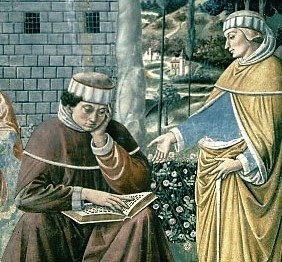
One question to consider is the recurrent image of reading that occurs in The Confessions. What significance might attach to those salient moments depicting Ambrose reading without moving his lips, and of course the famous "tolle lege" scene?

Monday, May 08, 2006

Augustine online


Some further online resources on Augustine. Here is an edition of the Confessions in Latin with commentary in English by noted scholar James J. O'Donnell. He offers further resources, including an introduction to Augustine's life and works.

Thursday, May 04, 2006

Augustine and Manichaeism

I still thought that it is not we who sin but some other nature that sins within us. It flattered my pride to think that I incurred no guilt and, when I did wrong, not to confess it... I preferred to excuse myself and blame this unknown thing which was in me but was not part of me. The truth, of course, was that it was all my own self, and my own impiety had divided me against myself. My sin was all the more incurable because I did not think myself a sinner.
Our next session will address the first nine books of Augustine's Confessions. Early on, Augustine describes his involvement with Manichaeism. For some background on this sect, which was declared heretical by the early Christian Church, go here.

Monday, April 24, 2006

Tabernacle and Ark


See this useful discussion of the Tabernacle, with references to an annotated online version of Exodus. A replica of the Tabernacle is described and pictured here.

Wednesday, April 05, 2006

Choice of text


Looking ahead to May, when we will read St. Augustine's Confessions, Arline has suggested this Oxford edition. The translation is by Henry Chadwick.

Sunday, April 02, 2006

Lycurgus


Our next session is devoted to Lycurgus, the legendary lawgiver of Sparta. Plutarch's Life, translated by Dryden, is here. As we are in the process of reading Exodus, it's worth considering the differences in how the entire matter of the Law is thought and rendered in Plutarch, versus how it comes into play in the books of Moses.

For further exploration: You might find Plutarch's parallel account of the Roman king, Numa Pompilius, of interest. He gave Rome certain of its key values and institutions, much as Lycurgus did with Sparta. If Plutarch's Life of Numa is too long, there's a useful brief account of his life and works on Wikipedia.

Friday, March 24, 2006

Exodus


On March 29, Mary Rosner will begin our reading of Exodus. The first 20 chapters are filled with narrative action. What is the essential story here? How does it follow, if it does, from Genesis? How does it relate to the institution of the Law which takes place at the exact center of Exodus?


Sunday, March 19, 2006

Socrates in the seaport


The Republic begins during a festival at Piraeus in honor of Bendis, a goddess recently imported to Athens from Thrace. The settings of Platonic dialogues often make oblique comments upon their subjects. What does this one suggest?

Saturday, February 25, 2006

The Republic


For our meetings on March 8th and March 22nd, Pat will take up selections from Plato's Republic. Any edition of the text is fine, several are online, including the Jowett translation.

Tuesday, February 07, 2006

Visualizations of Joseph

Click on the images for larger versions:


Guido Reni, Joseph and Potiphar's Wife, c. 1631


Michaelangelo, Jacob Joseph, Sistine ceiling