Scientific American:
Can culture be decoded like a genome? A team from Harvard University has teamed up with Google to crack the spines of 5,195,769 digitized books that span five centuries of the printed word with the hopes of giving the humanities a more quantitative research tool.
The Google Books Ngram Viewer, launched online December 16 and described in a paper in Science, allows Web users to query their respective areas of interest based on n-grams (a method of modeling sequences in natural language). The Harvard team is calling their analysis "culturomics" based on the notion that culture "is something you can study like evolution in biology," says Jean-Baptiste Michel, a postdoctoral researcher in Harvard's psychology department and in the Program for Evolutionary Dynamics, who helped lead the charge with Aiden. As a gene or phenotype changes over time, so, too, the researchers propose, do cultural sensibilities.
The Economist suggests that science is invading the humanities:
Reading by numbers
Science invades the humanities
But what if this sort of rich stew of millions of books also manages to humanize the sciences?
Ngram Viewer

Reading classical works aloud in Sarasota, and talking about them.
Friday, December 17, 2010

Thursday, December 16, 2010
At the Museum of Fine Arts in St. Petersburg
At the Museum of Fine Arts in St. Pete:

Theater in Ancient Art: The William Knight Zewadski Collection
This exhibition of approximately 50 antiquities, dating from the sixth century B.C. to the fourth century A.D., celebrates the theater tradition in Greek, Roman, and Etruscan art and culture. The artworks recreate a theatrical experience that was communal, often celebratory, and sometimes erotic. Found here are not only large-scale vases with finely executed paintings, but also objects used in daily life such as oil lamps, loom weights, and a theater ticket. Highlights include the Calyx Krater—depicting Orestes, his sister Electra, and Apollo, the god of Delphi—and two vessels by the Darius Painter, considered the most erudite and important artist of Apulian pottery (present-day southern Italy). These holdings, on extended loan to the Museum by trustee William Knight Zewadski, comprise one of the most comprehensive American collections of its kind and rival similar groupings in the Getty Museum and the Metropolitan Museum of Art.

This exhibition of approximately 50 antiquities, dating from the sixth century B.C. to the fourth century A.D., celebrates the theater tradition in Greek, Roman, and Etruscan art and culture. The artworks recreate a theatrical experience that was communal, often celebratory, and sometimes erotic. Found here are not only large-scale vases with finely executed paintings, but also objects used in daily life such as oil lamps, loom weights, and a theater ticket. Highlights include the Calyx Krater—depicting Orestes, his sister Electra, and Apollo, the god of Delphi—and two vessels by the Darius Painter, considered the most erudite and important artist of Apulian pottery (present-day southern Italy). These holdings, on extended loan to the Museum by trustee William Knight Zewadski, comprise one of the most comprehensive American collections of its kind and rival similar groupings in the Getty Museum and the Metropolitan Museum of Art.
Wednesday, December 15, 2010
Of angels and regicide


A few links pursuant to our discussion today of Book 5 of Paradise Lost:
The author of the treatise on the angels entitled Celestial Hierarchy, is known today as Pseudo-Dionysius the Areopagite. The "pseudo" was added later to distinguish him from an Athenian convert of St. Paul mentioned in Acts 17:34. A bit more about Dionysius is here.
Mystical Theology, another brief work by Pseudo-Dionysius, is here.
As for our poet's writings on regicide, Milton wrote more than one defense of the actions taken by Cromwell, where the regicide is discussed and defended:
With the parliamentary victory in the Civil War, Milton used his pen in defence of the republican principles represented by the Commonwealth. The Tenure of Kings and Magistrates (1649) defended popular government and implicitly sanctioned the regicide; Milton’s political reputation got him appointed Secretary for Foreign Tongues by the Council of State in March 1649. Though Milton's main job description was to compose the English Republic's foreign correspondence in Latin, he also was called upon to produce propaganda for the regime and to serve as a censor. In October 1649 he published Eikonoklastes, an explicit defence of the regicide, in response to the Eikon Basilike, a phenomenal best-seller popularly attributed to Charles I that portrayed the King as an innocent Christian martyr. A month after Milton had tried to break this powerful image of Charles I (the literal translation of Eikonoklastes is 'the image breaker'), the exiled Charles II and his party published a defence of monarchy, Defensio Regia Pro Carolo Primo, written by the leading humanist Claudius Salmasius. By January of the following year, Milton was ordered to write a defence of the English people by the Council of State. Given the European audience and the English Republic's desire to establish diplomatic and cultural legitimacy, Milton worked more slowly than usual, as he drew on the learning marshalled by his years of study to compose a riposte. On 24 February 1652 Milton published his Latin defence of the English People, Defensio Pro Populo Anglicano, also known as the First Defence. Milton's pure Latin prose and evident learning, exemplified in the First Defence, quickly made him a European reputation, and the work ran to numerous editions.[27]
In 1654, in response to an anonymous Royalist tract “Regii sanguinis clamor”, a work that made many personal attacks on Milton, he completed a second defence of the English nation, Defensio secunda, which praised Oliver Cromwell, now Lord Protector, while exhorting him to remain true to the principles of the Revolution. Alexander Morus, to whom Milton wrongly attributed the Clamor (in fact by Peter du Moulin), published an attack on Milton, in response to which Milton published the autobiographical Defensio pro se in 1655. In addition to these literary defences of the Commonwealth and his character, Milton continued to translate official correspondence into Latin. The probable onset of glaucoma finally resulted in total blindness by 1654, forcing him to dictate his verse and prose to amanuenses (helpers), one of whom was the poet Andrew Marvell. One of his best-known sonnets, On His Blindness, is presumed to date from this period.
Saturday, December 04, 2010
Milton dictating to his daughters
This image of Milton's daughter taking down the poetry of Paradise Lost is by Swiss-born painter Henry Fuseli. Jutta had shared it some time ago, but Google had a glitch with images on blogs.


Friday, December 03, 2010
Tales told by Socrates and Raphael

As has been mentioned before, Verity's notes to Paradise Lost, some of which are available online, are quite sensible and useful. His notes to Books 5 and 6 can be accessed here.
Of the Father's 16-line decree that begins on line 600 announcing the Son, his rule, his power of mediating the Father's glory, word and will, the editor wisely begs off, saying, "upon the particular theological bearing of this passage it would, I think, be out of place to comment," confining his note to scriptural sources, of which there are several.
Rather than look at the theology (we did, somewhat, in our last session, finding it more subtle, cryptic and complex than its austere brevity lets on), I want to suggest that the shape of Raphael's story might offer some interesting parallels and contrasts with Plato's cave allegory, which Socrates tells in Republic 7. The reasons for the comparison should become clear.
In the Republic, Socrates describes the human condition as essentially benighted. We are bound, like prisoners, fixed in the darkness, compelled to look at shadows of stage props. The props are behind us, between our backs and the fire that projects their images on the cave wall.
The story tells how one of these turns his neck and sees the two-dimensional props, and immediately understands that he's been seeing something of less substance than these. He's then dragged out of the cave into the bright light of day, where he is at first blinded, then gradually becomes accustomed to the sun's illuminating actual things. Socrates assures us that if this fellow were to return to tell his fellow cave dwellers what he saw, they would take him for a madman. But the shape of the story is clear: it's a journey through space, a paradigm of the eye and of light. It moves from darkness and servitude to light and freedom, from illusion to truth, from a kind of dreamworld to a stable, clear and serene upper world where one can contemplate things as they really are. So far, Plato's tale can be said to correspond to the pervasive solar imagery of dawn in Book 5 -- a process of gradual illumination.
If we turn to the story Raphael tells Adam and Eve, we find an parallel ascent, from Nature, the garden, the flower that turns to the sun, upward along a dynamic scale of being which follows the sublimation being described by the Angel as all things are consumed, transformed and refined. At a certain point, prompted by Adam's questions, Raphael has to pause and make clear that he is about to speak of warring spirits and high matter beyond the reach of human experience:
how shall I relate
To human sense th' invisible exploits [ 565 ]
Of warring Spirits; how without remorse
The ruin of so many glorious once
And perfet while they stood; how last unfould
The secrets of another World, perhaps
Not lawful to reveal? yet for thy good [ 570 ]
This is dispenc't,
To human sense th' invisible exploits [ 565 ]
Of warring Spirits; how without remorse
The ruin of so many glorious once
And perfet while they stood; how last unfould
The secrets of another World, perhaps
Not lawful to reveal? yet for thy good [ 570 ]
This is dispenc't,
and what surmounts the reach
Of human sense, I shall delineate so,
By lik'ning spiritual to corporal forms,
As may express them best, though what if Earth
Be but the shaddow of Heav'n, and things therein [ 575 ]
Each to other like, more then on earth is thought?
Of human sense, I shall delineate so,
By lik'ning spiritual to corporal forms,
As may express them best, though what if Earth
Be but the shaddow of Heav'n, and things therein [ 575 ]
Each to other like, more then on earth is thought?
One might be tempted here to find a suggestion of Platonism -- the spiritual world is to the physical world as Plato's Forms are to the shadowy figures on the walls of the cave.
But the story Raphael goes on to tell is anything but a journey that ends in gradual, eye-opening enlightenment. Instead we are carried back in time to a prime moment before our world was made. And we hear, rather than see, an act of power. God decrees the rule of his Son, and almost instantaneously Satan conceives malice, revolts, and launches the cataclysm of Book 6. Instead of a tranquil contemplative conclusion, Raphael's tale rises to a moment of perfect order; at God's Word, heavenly order shatters.
But the story Raphael goes on to tell is anything but a journey that ends in gradual, eye-opening enlightenment. Instead we are carried back in time to a prime moment before our world was made. And we hear, rather than see, an act of power. God decrees the rule of his Son, and almost instantaneously Satan conceives malice, revolts, and launches the cataclysm of Book 6. Instead of a tranquil contemplative conclusion, Raphael's tale rises to a moment of perfect order; at God's Word, heavenly order shatters.
Raphael's story is but a beginning -- an enigmatic opening of a story still unfolding. He will go on to speak of Satan's rout and fall, which brings us back to the opening of Book 1. But is this a purely cyclical structure? With the creation in Book 7, another chapter begins; it will encompass another fall, then all of human history, then look beyond history.
The shape of Milton's story strongly diverges from Plato's. Where the cave dweller begins in dark servitude and ascends to brilliant plenitude, the tale of the angel and the poet begins in sweetness and light, and falls into disorder and harsh history. In Plato, knowledge, gained by toil and struggle, is the goal and liberating end of education; for Adam and Eve, knowledge will neither be the goal, nor the means of leaving or repairing the fallen world. Still, the Greek world's highest literary form was tragedy, where the culture of Milton and Dante finds its fullest expression in the comic.
The shape of Milton's story strongly diverges from Plato's. Where the cave dweller begins in dark servitude and ascends to brilliant plenitude, the tale of the angel and the poet begins in sweetness and light, and falls into disorder and harsh history. In Plato, knowledge, gained by toil and struggle, is the goal and liberating end of education; for Adam and Eve, knowledge will neither be the goal, nor the means of leaving or repairing the fallen world. Still, the Greek world's highest literary form was tragedy, where the culture of Milton and Dante finds its fullest expression in the comic.
Wednesday, December 01, 2010
Labor, Science, Adamic Innocence
Jutta sends along a review of a substantial new book about early modern ways of thinking about science, labor, and the public sphere. Labors of Innocence in Early Modern England by Joanna Picciotto is about
"the fertile conjunction between literature and science as it developed in seventeenth- and early eighteenth-century England, offering new discussions on the ideas and texts of authors such as Francis Bacon, Gerrard Winstanley, John Evelyn, Robert Boyle, Robert Hooke, Thomas Sprat, Andrew Marvell, William Davenant, John Locke, Daniel Defoe, Joseph Addison, Celia Fiennes, and above all John Milton."
In the Renaissance vision of an unfallen Adam Picciotto finds the roots of a labor that leads to the producing of truth in a disinterested way, which in turn becomes a model for benign experimentalism in modern science, according to the review. More here.
Such a view would seem congruent with the vision of man in nature that emerges in Book 5 of Paradise Lost. In the garden, Adam and Eve are rooted deeply in a natural world whose order the human mind can labor to comprehend, cultivate, and master.
Friday, November 26, 2010
High matter, warring spirits
The natural language and ordering of the world as found in Adam and Eve's morning orison, and in Raphael's description of the system of nature -- essentially a kind of heliotropism, all in keeping with the metaphorics of dawn in Book V -- seem to be jettisoned as the angel, in response to Adam's request, begins to tell the origin of the war in heaven.
It might be worth asking some straightforward questions about how Raphael/Milton choose to tell this story. For example, while it seems to narrate a tale with a clear beginning, a sharp conflict, and a definite ending (at the end of Book VI, which leads right into the opening scene of Book I), does it reflect the natural ordering of time, space, agency, etc. that belong to nature and science, or is this a different kind of telling? Does it obey what we normally think of as the dictates of Reason?
In the description of the angelic congregation (580 ff), much is made of hierarchies, degrees, flags, a kind of militant order, and geometry is invoked:
How does the angels' meal compare with that of Adam, Eve and Raphael?
Since all the angels were used to worshiping the Father, why does Satan begin to conceive malice when he hears the decree about the Son?
How odd is it to find God smiling, and the Son joining in his laughter at Satan?
How cogent is Satan's reasoning when he says:
Why does Abdiel leave the towers of Satan behind?
High matter thou injoinst me, O prime of men,
Sad task and hard, for how shall I relate
To human sense th' invisible exploits [ 565 ]
Of warring Spirits;
It might be worth asking some straightforward questions about how Raphael/Milton choose to tell this story. For example, while it seems to narrate a tale with a clear beginning, a sharp conflict, and a definite ending (at the end of Book VI, which leads right into the opening scene of Book I), does it reflect the natural ordering of time, space, agency, etc. that belong to nature and science, or is this a different kind of telling? Does it obey what we normally think of as the dictates of Reason?
In the description of the angelic congregation (580 ff), much is made of hierarchies, degrees, flags, a kind of militant order, and geometry is invoked:
Thus when in OrbesAny observations about this sort of mathematical ordering?
Of circuit inexpressible they stood, [ 595 ]
Orb within Orb
How does the angels' meal compare with that of Adam, Eve and Raphael?
Since all the angels were used to worshiping the Father, why does Satan begin to conceive malice when he hears the decree about the Son?
How odd is it to find God smiling, and the Son joining in his laughter at Satan?
How cogent is Satan's reasoning when he says:
rememberst thouHow is Abdiel "seeing" when he says:
Thy making, while the Maker gave thee being?
We know no time when we were not as now;
I see thy fallHow does he hear/know of these decrees:
Determind,
other Decrees
Against thee are gon forth without recall;
Why does Abdiel leave the towers of Satan behind?
What other questions come to mind?
Sunday, November 21, 2010
"Happiness is a dangerous word"
A fine essay by Joan Bakewell about reading, the work of contemplation, and the precarious situation of public libraries in the UK. A BBC podcast available for the next seven days here.
Wednesday, November 17, 2010
Tuesday, November 16, 2010
A few books Jutta found
Jutta sends a note:
In the latest PMLA they were advisements for several Milton books by Duquesne U P. (800 666-2211)
Visionary Milton. Essays on Prophecy and Violence. Edited by Peter E. Medine, John T. Shawcross and David V. Urban $60
The Divorce Tracts of John Milton. Texts and Contexts. Ed. by Sara J. Van den Berg and W. Scott Howard $75
Milton and Monotheism by Abraham Stoll. $60.
Another currently featured on the Duquesne U.P. site:
The Development of Milton's Thought. Law, Government, Religion. John T. Shawcross. $60.
Also:
Giordano Bruno: Philosopher/Heretic. By Ingrid D. Rowland. Farrar, Straus and Giroux, $27.
Monday, November 15, 2010
Dawn in P.L. 5
If we needed assurance that Paradise Lost breaks neatly into thirds, consider the opening of Book 9:
The poem that opens with Satan landing in hell with a thud turns, in book 5, to a human state suffused with images of dawn, of flowers and fruits, of the primal world of humanity working the world and conversing with angels. There's a striking difference between Adam and Eve's work in the garden and the harsher world of Virgil's Georgics, where the varied labors of cultivation require unremitting effort as well as study. If labor vincit omnia in Virgil, it does so with the qualifier improbus, whose relevant meanings include restless, indomitable, persistent, as well as, connotatively, fierce and violent. One result of the Fall is that we fell into Virgil's world of labor improbus.
The opening of Book 5, the mid-section of the epic, puts enough stress on dawn that the reader would be well advised to consider the manifold chain of images that invariably comes with it: figures of a gradual (rosie steps) enlightening that entails an ever more detailed differentiation of the visible realm; initiation of the temporal realm of hours, of the approach of the sun and the train of things that derive from it, the clearing of mists, the creation of rain leading to the biosphere, where all things consume and are consumed. And Dawn is naturally accompanied by the fairest of stars (166).
Adam's paean to the sun (of this great World both Eye and Soule) greets the day, and Dawn is the "sure/pledge of day" (167-68). Before the hours run, at the very beginning, is Prime - it's worth noting how that word returns four times in Book 5. The first occurrence is when we hear Adam, calling to the still sleeping Eve, we lose the prime (21).
Lucifer precedes dawn, but dawn is followed by the advent of Raphael, who, to Adam
Dawn and primacy resonate throughout: Look, for example, how at the end of Book 5, Satan can't swallow the idea that he was made, authored. Parodying the voice out of the whirlwind of Job (parody is the ultimate in secondary tropism), Satan can't accept that he is not primordial:
That we were formd then saist thou? and the work
Of secondarie hands, by task transferd
From Father to his Son? strange point and new! [ 855 ]
Doctrin which we would know whence learnt: who saw
When this creation was? rememberst thou
Thy making, while the Maker gave thee being?
We know no time when we were not as now;
Know none before us, self-begot, self-rais'd [ 860 ]
By our own quick'ning power, when fatal course
Had circl'd his full Orbe, the birth mature
Of this our native Heav'n, Ethereal Sons.
The speed with which the angels intuit, decide and act is in marked contrast to the gradual taking in and development of knowledge, thought and feeling in Adam and Eve, or for that matter, in the reader of Paradise Lost. For Satan there is no logical argument or intuitable evidence that anything, including the Sun/Son, preexisted him. It is never going to dawn on him that he derives from something more primal than himself. The cogent logic of Book Five's images helps us see how and why no creature other than Lucifer could be the morning star.
NO more of talk where God or Angel Guest
With Man, as with his Friend, familiar us'd
To sit indulgent, and with him partake
Rural repast, permitting him the while
Venial discourse unblam'd:
The poem that opens with Satan landing in hell with a thud turns, in book 5, to a human state suffused with images of dawn, of flowers and fruits, of the primal world of humanity working the world and conversing with angels. There's a striking difference between Adam and Eve's work in the garden and the harsher world of Virgil's Georgics, where the varied labors of cultivation require unremitting effort as well as study. If labor vincit omnia in Virgil, it does so with the qualifier improbus, whose relevant meanings include restless, indomitable, persistent, as well as, connotatively, fierce and violent. One result of the Fall is that we fell into Virgil's world of labor improbus.
The opening of Book 5, the mid-section of the epic, puts enough stress on dawn that the reader would be well advised to consider the manifold chain of images that invariably comes with it: figures of a gradual (rosie steps) enlightening that entails an ever more detailed differentiation of the visible realm; initiation of the temporal realm of hours, of the approach of the sun and the train of things that derive from it, the clearing of mists, the creation of rain leading to the biosphere, where all things consume and are consumed. And Dawn is naturally accompanied by the fairest of stars (166).
Adam's paean to the sun (of this great World both Eye and Soule) greets the day, and Dawn is the "sure/pledge of day" (167-68). Before the hours run, at the very beginning, is Prime - it's worth noting how that word returns four times in Book 5. The first occurrence is when we hear Adam, calling to the still sleeping Eve, we lose the prime (21).
Lucifer precedes dawn, but dawn is followed by the advent of Raphael, who, to Adam
seems another MornThe angel will speak to Adam and Eve of high things - the appointment of the Son as head, the revulsion of Satan, and the prophetic voice of Abdiel. At this point we are beyond the natural light of the sun, but it would be worthwhile to consider echoes of the first half of Book 5 as they occur in the second half -- Satan's speech to Beelzebub, or words such as "impair'd" and "entertain." Milton seems to not use a word without its interestingly resonating with other instances of the "same" word.
Ris'n on mid-noon
Dawn and primacy resonate throughout: Look, for example, how at the end of Book 5, Satan can't swallow the idea that he was made, authored. Parodying the voice out of the whirlwind of Job (parody is the ultimate in secondary tropism), Satan can't accept that he is not primordial:
That we were formd then saist thou? and the work
Of secondarie hands, by task transferd
From Father to his Son? strange point and new! [ 855 ]
Doctrin which we would know whence learnt: who saw
When this creation was? rememberst thou
Thy making, while the Maker gave thee being?
We know no time when we were not as now;
Know none before us, self-begot, self-rais'd [ 860 ]
By our own quick'ning power, when fatal course
Had circl'd his full Orbe, the birth mature
Of this our native Heav'n, Ethereal Sons.
The speed with which the angels intuit, decide and act is in marked contrast to the gradual taking in and development of knowledge, thought and feeling in Adam and Eve, or for that matter, in the reader of Paradise Lost. For Satan there is no logical argument or intuitable evidence that anything, including the Sun/Son, preexisted him. It is never going to dawn on him that he derives from something more primal than himself. The cogent logic of Book Five's images helps us see how and why no creature other than Lucifer could be the morning star.
Tuesday, November 09, 2010
"The Knight-Errant of Philosophy"
That is the epithet assigned to Giordano Bruno by Pierre Bayle, according to this brief account of Bruno's life and thought.
Bruno was born near Naples in 1548 and died in flames in Rome in 1600. In between, he lived a restless life, moving through various Italian cities to Paris, where he interested the king in his famed arts of memory, then to England, where he befriended Sir Philip Sydney, gained the favor of Elizabeth, and published a few key works, including the Heroic Furors, dedicated to Sydney. He visited Oxford while there, and, as he'd done in other locales, he departed in disgust, writing that the Oxford profs "knew more about beer than about Greek."
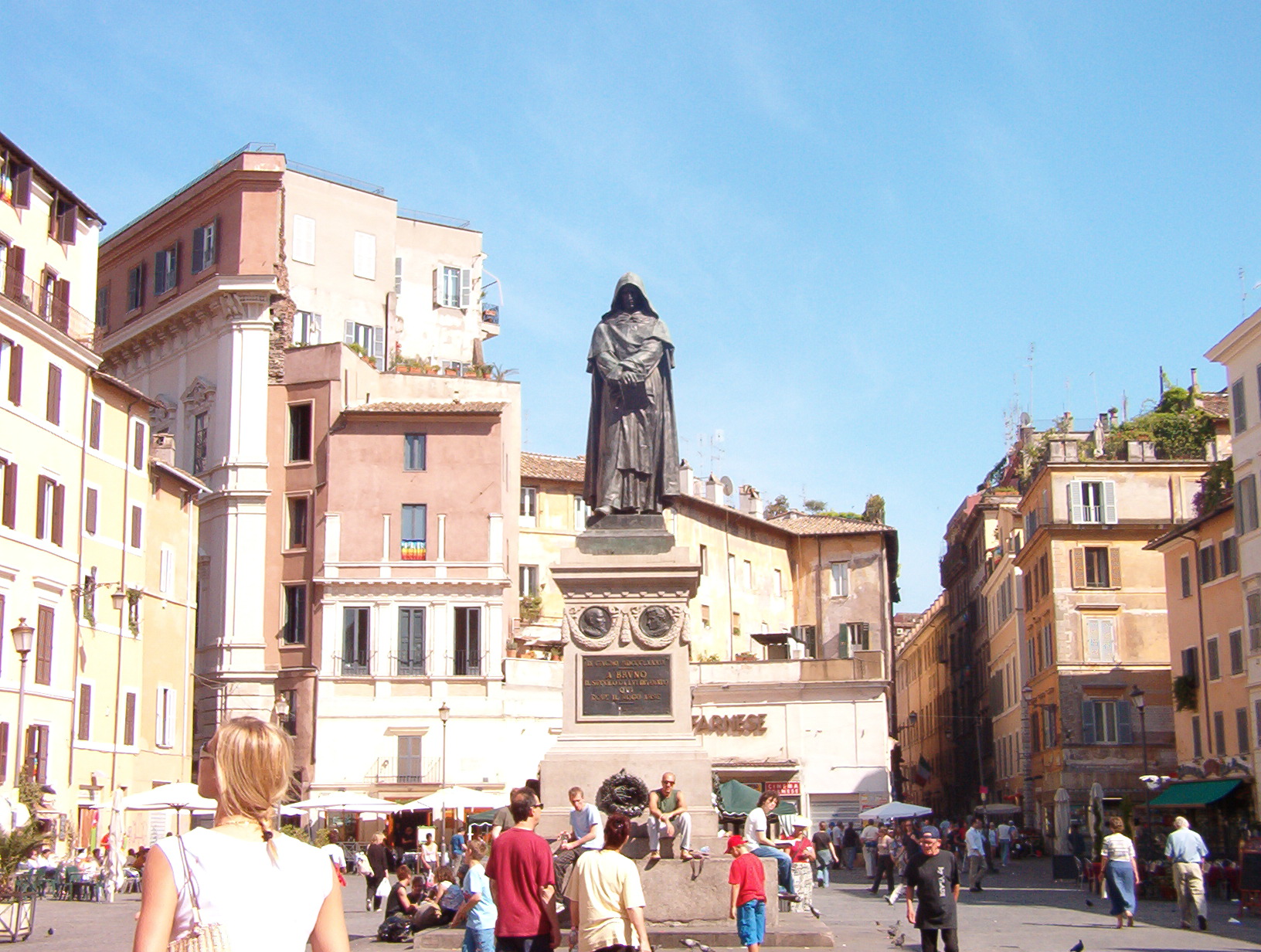
From England he went to Germany, where he managed to be excommunicated by the Lutherans, then on to Venice, perhaps the most intellectually "open" city of the day. It was there that the Inquisition arrested him and had him extradited to Rome, where he remained imprisoned for 7 years until his execution in the Campo dei Fiori on Feb. 17, 1600. In that Roman square, a statue of the rogue priest/theologian/natural philosopher/magus/satirist/playwright/heretic memorializes the event.
Whatever Bruno's philosophy ultimately has to teach, it's fair to say that it is hauntingly evocative - richly figural and allegorical, tending to meld disciplines and the study of nature, theology, and science as if they were so many elements of a vast Bouillabaisse. Every account attempting to summarize some core of his teaching sounds unlike every other account. The body of Bruno's work, like its earthly equivalent, vanishes within the fires it feeds. Let's hear a bit of what he sounds like (in translation):
One can perhaps see in this description how Milton might have recognized a kindred imagination:
Bruno was born near Naples in 1548 and died in flames in Rome in 1600. In between, he lived a restless life, moving through various Italian cities to Paris, where he interested the king in his famed arts of memory, then to England, where he befriended Sir Philip Sydney, gained the favor of Elizabeth, and published a few key works, including the Heroic Furors, dedicated to Sydney. He visited Oxford while there, and, as he'd done in other locales, he departed in disgust, writing that the Oxford profs "knew more about beer than about Greek."
From England he went to Germany, where he managed to be excommunicated by the Lutherans, then on to Venice, perhaps the most intellectually "open" city of the day. It was there that the Inquisition arrested him and had him extradited to Rome, where he remained imprisoned for 7 years until his execution in the Campo dei Fiori on Feb. 17, 1600. In that Roman square, a statue of the rogue priest/theologian/natural philosopher/magus/satirist/playwright/heretic memorializes the event.
Whatever Bruno's philosophy ultimately has to teach, it's fair to say that it is hauntingly evocative - richly figural and allegorical, tending to meld disciplines and the study of nature, theology, and science as if they were so many elements of a vast Bouillabaisse. Every account attempting to summarize some core of his teaching sounds unlike every other account. The body of Bruno's work, like its earthly equivalent, vanishes within the fires it feeds. Let's hear a bit of what he sounds like (in translation):
It is proof of a base and low mind for one to wish to think with the masses or majority, merely because the majority is the majority. Truth does not change because it is, or is not, believed by a majority of the people.
There is no absolute up or down, as Aristotle taught; no absolute position in space; but the position of a body is relative to that of other bodies. Everywhere there is incessant relative change in position throughout the universe, and the observer is always at the center of things.
The universe is then one, infinite, immobile.... It is not capable of comprehension and therefore is endless and limitless, and to that extent infinite and indeterminable, and consequently immobile.
In this infinite space is placed our universe (whether by chance, by necessity or by providence I do not now consider).
Make then your forecasts, my lords Astrologers, with your slavish physicians, by means of those astrolabes with which you seek to discern the fantastic nine moving spheres; in these you finally imprison your own minds, so that you appear to me but as parrots in a cage, while I watch you dancing up and down, turning and hopping within those circles.
My son, I do not say these are foals and those asses, these little monkeys and those great baboons, as you would have me do. As I told you from the first, I regard them [Aristotle; Plato] as earth's heroes. But I do not wish to believe them without cause, nor to accept those propositions whose antitheses (as you must have understood if you are not both blind and deaf) are so compellingly true.
One can perhaps see in this description how Milton might have recognized a kindred imagination:
Bruno also affirmed that the universe was homogeneous, made up everywhere of the four elements (water, earth, fire, and air), rather than having the stars be composed of a separate quintessence. Essentially, the same physical laws would operate everywhere, although the use of that term is anachronistic. Space and time were both conceived as infinite.. . .
Under this model, the Sun was simply one more star, and the stars all suns, each with its own planets. Bruno saw a solar system of a sun/star with planets as the fundamental unit of the universe. According to Bruno, infinite God necessarily created an infinite universe, formed of an infinite number of solar systems, separated by vast regions full of Aether, because empty space could not exist. (Bruno did not arrive at the concept of a galaxy.) Comets were part of a synodus ex mundis of stars, and not—as other authors maintained at the time—ephemeral creations, divine instruments, or heavenly messengers. Each comet was a world, a permanent celestial body, formed of the four elements.Clearly, Bruno was no Girolamo Savonarola (1452-1498). Indeed, had Bruno lived during the time of that rigorous Dominican, it's likely that his furious books, along with his hide, would have fed the Bonfire of the Vanities. It's equally likely he'd have said to Savonarola what he reportedly told the judges who ordered him to be burned:
Perchance you who pronounce my sentence are in greater fear than I who receive it.
Subscribe to:
Posts (Atom)