Thursday, December 14, 2006

A footnote to our discussion of cantos 10 & 11

The evening of our discussion of cantos 10-11, I happened to watch Francesco, giullare di Dio, the 1950 film directed by Roberto Rossellini and written by him and Federico Fellini. The English title is known either as Francis, God's Jester, or The Flowers of St. Francis, and the DVD was released last year by the Criterion Collection.

Rossellini is an acquired taste for many. This film, which is a series of vignettes that explore aspects of medieval notions of simplicity, folly (the "sacred fool") and humility, was shot with actual Italian monks playing Francis of Assisi and his band of followers, shows the influence of Fellini's imagination. (It is available for rental at Video Renaissance, 2243 Bee Ridge Rd.)

The reason for the mention: If you do happen to get hold of the DVD, don't miss the English Prologue that is part of the extras on the disk. It was apparently created to introduce the world of Francis through art of his time, and was later removed. It contains stills and details from the works of Cimabue, Giotto and Orcagna -- including several images of Inferno, Purgatorio and Paradiso which are clearly indebted to Dante's visibile parlare.
Triumph of Death in the Pit of Hell, Orcagna, 1348

Monday, December 11, 2006

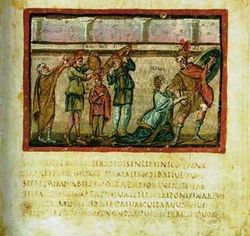
The Stamp of Rome

At Mussy's suggestion, here's a piece on the Aeneid from the NY Times' Connections - posted in full because the Times tends to limit access after a few days:

Out of Epic Wars, Another Epic Is Born, the One Called Civilization

By EDWARD ROTHSTEIN

Aeneas, as far as we can see, is spared the trauma of a hero’s death, the kind of prophesied calamity that brought Achilles down at the height of his powers. Instead, Aeneas is last seen, at the close of Virgil’s Aeneid, triumphantly planting his iron sword “hilt-deep in his enemy’s heart.” But has there been a time in recent memory when Aeneas’s literary corpse has not been wrestled over, when this Trojan warrior, brought to such vivid life by Virgil, has really been able to rest in peace?

Read now Robert Fagles’s new pulsing, lyrical translation of the Aeneid (Viking), with its eloquent mixture of high rhetoric and conversational ease, and see too if — as arguments rage over war and peace, civilization and barbarism — Aeneas stands a chance.

He suffers the fate of having an unsettled place in the pantheon of heroes because Virgil gives him a far grander role to play than Homer’s supra-human figures had in the Iliad and the Odyssey. Aeneas is not just a godlike tempestuous warrior like Achilles, who is gradually inducted into human culture with all its constraints and demands. He is not just a brilliant schemer like Odysseus, who simply wishes to return home after years of war and is buffeted by the tricks of gods and Fates and men.

Aeneas, the Trojan hero who carries his aged father on his shoulders out of his burning city, has a mission that reaches across history and stretches centuries into the future, a task that the gods remind him may not be avoided or shirked and that Virgil, writing in the third decade B.C., was beginning to see come to fruition. Aeneas’s task was to lead his fellow survivors of the great Trojan War onto the shores of Italy, where — after terrible battles — his descendants would eventually found Rome itself.

Aeneas was brought to epic life by Virgil at a time when a century of Roman civil war had come to an end, when Augustus’s leadership promised the establishment of the Roman Empire. And Aeneas is imagined creating a nation that, as Jove suggests, would “bring the entire world beneath the rule of law.”

That is what is at stake in the Aeneid. The individual hero must fulfill an imperial destiny. The goddess Juno, nursing an ancient grudge, strives to keep Aeneas from landing in Italy, then tries to keep him from surviving there, but his destiny is greater than any god’s mischief. It also forces Aeneas to jettison the love of Dido and lead the Trojans into yet another horrific war. This is a founding myth, resembling those of other ancient lands: there is a chosen people who must endure hardships and defeats for the promise of future glory. The trials test their leader, who himself will never see the new world established, though he makes it all possible.

But this is more than a national epic. It is not just about the founding of a country or the establishment of a people out of a ruinous past. Rome, the Aeneid implies (and we can imagine Virgil nodding to his patrons), will be more than a light unto the nations; it will establish a new form of governance. Aeneas is the founder of something we now call civilization.

That, though, is where his posthumous trouble begins. Perhaps the Romans saw in Virgil’s meticulously described battles forerunners of Julius Caesar’s victories. (Caesar imagined, after all, that he was a descendant of Aeneas.) Perhaps in later eras Christianity could see hints of its own vision latent in the Aeneid. (Aeneas’s journey to the realm of the dead, after all, inspired Dante to make Virgil the experienced guide in his “Divine Comedy.”)

But in recent decades, when even the notion of civilization has come under challenge for its claims of ethical and social superiority, Aeneas has sometimes been portrayed as a kind of patsy for imperialism, mouthing higher goals while succumbing to reckless fury as he spills the bowels of his enemies on the earth. The argument has been made that Virgil’s project was actually ironic, anti-Augustan: he showed how civilization itself is drenched in blood, with self-celebratory history being written by the victors.

While Aeneas is supposedly held up as an embodiment of familial piety, he is so vulnerable to fury that he loses sight of things. As Troy burns, he glimpses the beauteous Helen, the root cause of the city’s destruction; “what joy, to glut my heart with the fires of vengeance,” he thinks, and he is about to take revenge on her when his mother, the goddess Venus, must remind him that his own family needs rescue.

Then, as he carries his father to safety, he forgets to look back and care for his wife, who is slaughtered. And at the very close of the epic he rejects a civilized appeal for restraint by his enemy Turnus and gives way to “savage grief” and “rage,” sending Turnus “down to the shades below.”

Glutting one’s heart with savage fires is not precisely something we imagine as a sign of civilization. And these battles for the future unfold with almost pornographic horror. Even Aeneas’s men, in the midst of recreational games, can whine for prizes, their vanity and passions stronger than any visions of communal good.

And yet, on his courageous descent into the Underworld, Aeneas is shown the unfolding of history, past and present. The shade of his revered father, Anchises, speaks of the future, specifying precisely what Rome’s achievement will be. Other civilizations he says, will “draw from the block of marble features quick with life” or “chart with their rods the stars that climb the sky.”

Others, that is, will be masters of the arts and sciences. Anchises says:

But you, Roman, remember, rule with all your power
the peoples of the earth — these will be your arts:
to put your stamp on the works and ways of peace,
to spare the defeated, break the proud in war.

The arts of rule: that is where Virgil himself says the triumph will be; the “rule of law” is how Jove puts it. As Virgil shows again and again, that rule is no small matter. It may be won by the sword; Aeneas, though, shows how much more is required. He displays compassion, delicacy, courage, insight into the vanquished, desire for an “eternal pact of peace.” These are all elements of civilization.

But can the sword ever be put aside, even with civilization’s triumph? Aeneas’s own frailties suggest that it cannot: he can “break the proud” but not always “spare the defeated.” The “works and ways of peace” are always vulnerable.

Jove himself, envisioning a Rome in which the Gates of War are welded shut, portrays the “frenzy of civil strife” as a live being, shackled, “monstrously roaring out from his bloody jaws.” Even when all intentions are good, there will be that persistent roar: misunderstandings, flaws, eruptions of desire, assertions of power — the mischief of the gods and the treachery of the heart.

This vision makes the Aeneid strong and somber and prescient, which is how Mr. Fagles’s English renders it. The Aeneid, he has suggested (thinking, he had said, of contemporary events), exhorts empires to behave. But it does not dismiss the ideal of civilization or the labors demanded or the persistent dangers faced; it offers a realist prophecy of war and peace, heralding civilization along with its discontents.

Saturday, December 09, 2006

Bibliophilic and gryphonic


A book-loving friend sends a link to LibraryThing, a site for books and those who care about them. People enter titles of books they own, like, or hate, and can then find others who share the interest. Just tabbing across the top of the home page brings forums for discussion, a "zeitgeist" of users' current choices, favorite authors, etc., a blog and much else. (Perhaps too much else -- one can get lost in there for extended periods of time!)

LIbraryThing is the creation of a fellow named Tim Spalding, a webmaster who has another site rich in literary lore, Isidore of Seville, named after the famed medieval collector of knowledge and author (c.560-636 AD) of the Etymologies. There's much there about oracles, Cleopatra, Herodotus, Noah's Ark, and Griffins, among other things. More about Isidore here.

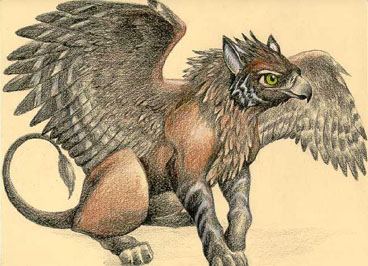
As we'll be encountering a griffin, or gryphon, at the top of the mountain, I'll put a few links here: Griffins in art -- a literary history of griffins -- and a description of the fabled lion/birds, from which the above illustration comes.

Wednesday, December 06, 2006

Notes on Purgatorio 12

Canto 12 completes the tripartite structure begun in Canto 10 which will be the pattern for each of the seven terraces of the deadly sins:
  1. Entering each Terrace, the pilgrim sees the “goad” – the depiction of the countervailing virtue that is the cure for the vice being purged.
  2. He meets the souls being purged.
  3. Leaving, he encounters the “check” – a representation of the vice that was just being addressed.
Here as he leaves off discussing human artistry he encounters 12 panels involving stories of pride, six from the Hebraic Old Testament tradition and six from the Greco Roman myths.

"Pride of place" goes to Satan. There was a lively discussion in the middle ages about how long it took Satan to fall once he was created. Any wagers on Dante's view?

Briareus, we remember from Hesiod's Theogony, was one of the hundred-handed (Hecatonchires) late offspring of Ouranos and Gaia:
Soon after they were born, their father, Uranus, threw them into the depths of Tartarus because he saw them as hideous monsters. In some versions of this myth, Uranus saw how ugly the Hecatonchires were at their birth and pushed them back into Gaia's womb, upsetting Gaia greatly, causing her great pain, and setting into motion the overthrow of Uranus by Cronus. In this version of the myth, they were only later imprisoned in Tartarus by Cronus.

The Hecatonchires remained there, guarded by the dragon Campe, until Zeus rescued them, hoping they would serve as good allies against Cronus. During the War of the Titans, the Hecatonchires threw rocks as big as mountains, one hundred at a time, at the Titans.
The emphasis upon the mimetic power of the images is evident from the anaphoric repetition of Vedea...Vedea...Vedea etc. What emerges from the 13-tercet description of the panels is on the one hand a balanced structure of vivid images of destruction and decapitation, and on the other an acrostic that spells the name of humanity - UOM - which apparently hid unnoticed by commentators until 1898.

The final panel is a vision of the abasement of Troy:

Vedeva Troia in cenere e in caverne;
o Ilïón, come te basso e vile
mostrava il segno che lì si discerne!

Any thoughts on this combination of mimesis (the images on the panels) with the emergence of this other kind of sign?

The canto ends with an angel coming to meet the pilgrim, the lifting of the first "P," and an unusual glimpse of Virgil smiling.

What do the various elements of the canto - the elaborate artifice, the actions of the characters - have to do with the nature of pride? If moral education is going on here, how is it occuring?

Saturday, November 25, 2006

Canto 11 note

The canto ends with another character, the illuminator, Oderisi,

l'honor d'Agobbio e l'onor di quell'arte
ch'alluminar chiamata e in Parisi

predicting that Dante will soon know the pain of exile and want. The hint of what is to come is elaborated on later, by Cacciaguida, Dante's noble ancestor whom he encounters in Paradiso. There in simple, stark terms, Dante gives us his experience of exile:

Tu lascerai ogni cosa diletta
piu caramente; e questo e quell strale
che l'arco de lo esilio pria saetta.

Tu proverai si come sa di sale
lo pane altrui, e come e duro calle
lo scendere e 'l salir per l'altrui scale.

Paradiso 17.55-60.

Friday, November 24, 2006

Canto 10: a few elements

This is the first terrace of Purgatory proper, with three images -- Dante calls them visibile parlare, speech made visible -- of antitypes of Pride: Mary, King David, Emperor Trajan.

Mary to the angel: "I am the Lord's servant," Mary answered. "May it be to me as you have said." Then the angel left her.

David:
12 Now King David was told, "The LORD has blessed the household of Obed-Edom and everything he has, because of the ark of God." So David went down and brought up the ark of God from the house of Obed-Edom to the City of David with rejoicing. 13 When those who were carrying the ark of the LORD had taken six steps, he sacrificed a bull and a fattened calf. 14 David, wearing a linen ephod, danced before the LORD with all his might, 15 while he and the entire house of Israel brought up the ark of the LORD with shouts and the sound of trumpets.

16 As the ark of the LORD was entering the City of David, Michal daughter of Saul watched from a window. And when she saw King David leaping and dancing before the LORD, she despised him in her heart.

17 They brought the ark of the LORD and set it in its place inside the tent that David had pitched for it, and David sacrificed burnt offerings and fellowship offerings [f] before the LORD. 18 After he had finished sacrificing the burnt offerings and fellowship offerings, he blessed the people in the name of the LORD Almighty. 19 Then he gave a loaf of bread, a cake of dates and a cake of raisins to each person in the whole crowd of Israelites, both men and women. And all the people went to their homes.

20 When David returned home to bless his household, Michal daughter of Saul came out to meet him and said, "How the king of Israel has distinguished himself today, disrobing in the sight of the slave girls of his servants as any vulgar fellow would!"

21 David said to Michal, "It was before the LORD, who chose me rather than your father or anyone from his house when he appointed me ruler over the LORD's people Israel—I will celebrate before the LORD. 22 I will become even more undignified than this, and I will be humiliated in my own eyes. But by these slave girls you spoke of, I will be held in honor."

23 And Michal daughter of Saul had no children to the day of her death.
Trajan and the widow:


There was storied the high glory of the Roman prince whose worth moved Gregory to his great victory; Of Trajan the emperor I speak: and a poor widow was at his bridle in the attitude of tears and grief.

Round about him appeared a trampling and throng of horsemen and the eagles in gold above him moved visibly in the wind. The poor creature among all these seemed to say: 'Lord, do me vengeance for my son who is slain, whereby my heart is pierced.'

And he to answer her: 'Now wait until I return.' And she, like a person in whom grief is urgent: 'My Lord, if thou do not return?' And he: 'One who shall be in my place will do it for thee'. And she: 'What to thee will be another's good deed if thou forget thine own?'

Wherefore he: 'Now comfort thee, for needs must I fulfil my duty ere I stir: justice wills and pity holds me back
.

At the conclusion of the three scenes:

Colui che mai non vide cosa nova
Produsse esto visibile parlare
Novello a noi perche qui non si trova.

The canto ends comparing the encumbered proud souls to corbels - stone brackets, sometimes in the form of human figures, that support a cornice or arch, often in a cathedral:

Monday, November 13, 2006

Points to ponder in Canto 9

The canto presents some unusual interpretive challenges beginning with the very first terzina:
La concubina di Titone antico
Gia s'imbiancava al balco d'oriente
Fuor de le braccia del suo dolce amico

The concubine of ancient Tithonus
Already was whitening herself on the eastern balcony
Away from the arms of her sweet lover
Aurora, or Eos, often rises to herald the day in the ancient epics, but she's Tithonus' wife, not concubine, and she ordinarily turns the sky rosy. Plus, at this point in the Purgatorio, it isn't dawn, it's only about 9 p.m. These oddnesses might give us pause, to ask: what's going on?


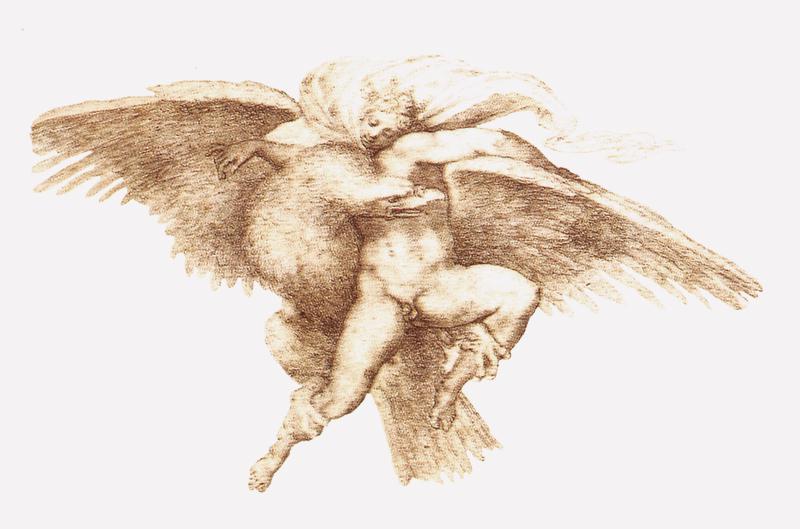
We might also want to think about the rape of Ganymede, and the horrible tale of Philomela, Procne and Tereus. What are these classical stories doing here, at the moment when Dante is being lifted up, not by a Greek God, but by St. Lucia (do you see any relevance in details of her story?), and carried to the threshold of Purgatory? Why does Dante, invoking a scene from Statius' Achilleid, likens himself upon awakening to Achilles as a child?


Up to this point, Dante and Virgil have only been in the anteroom, as it were. Purgatory proper begins at the door which opens at the end of the canto.

Saturday, November 11, 2006

immortal bees

though each a life of narrow span,
Ne'er stretched to summers more than seven, befalls,
Yet deathless doth the race endure, and still
Perennial stands the fortune of their line,
From grandsire unto grandsire backward told.

Bees are a rich classical topos. In Virgil's Georgics, they provide an emblem of the immortality of the species. Later in the same book, they occasion a story of expiation and rebirth:


Then, when the ninth dawn had led in the day,
To Orpheus sent his funeral dues, and sought
The grove once more. But sudden, strange to tell
A portent they espy: through the oxen's flesh,
Waxed soft in dissolution, hark! there hum
Bees from the belly; the rent ribs overboil
In endless clouds they spread them, till at last
On yon tree-top together fused they cling,
And drop their cluster from the bending boughs.
Bees enjoyed a long and distinguished afterlife in European publishing, as illustrated by this lovely blog.

Thursday, November 09, 2006

A few aspects of the status of Purgatory

Here are a few follow-ups to questions raised during our last session, taken from Wikipedia's basic article on Purgatory:

Besides the concept expressed in early Christian writings of purification and suffering after death, as well as the efficacy of prayer for the dead (see above), no explicit use of the Latin word purgatorium (purgatory) is recorded before the 11th century. One of the first documents to mention purgatorium by name was a letter from the Benedictine Nicholas of Saint Albans to the Cistercian Peter of Celle in 1176.

Dogmatic definition of purgatory was given in 1254, following the normal pattern of doctrinal clarification, with concepts having roots in Scripture and Tradition being given explicit names and further unambiguous theological description by dogmatic decrees as needed. ...

Though most Protestant churches embrace the somewhat similar doctrine of glorification, they largely reject explicit belief in Purgatory, especially in the precise Catholic theological definition. ...

Lutherans, following the later teachings of Martin Luther, deny the existence of purgatory and do not pray for people who have already died. Luther wrote in Question No. 211 in his expanded Small Catechism:

"We should pray for ourselves and for all other people, even for our enemies, but not for the souls of the dead."...

Protestant disbelief in "purgatory" partially centers on the idea that it implies that Christ's blood sacrifice on the cross was insufficient to save humanity in whole and represents a human desire to perform some works that can "assist" them through into Heaven.

Some Eastern Orthodox sources, including the Ecumenical Patriarchate, consider Purgatory to be among "inter-correlated theories, unwitnessed in the Bible or in the Ancient Church" that are not acceptable within Orthodox doctrine,[7] and hold to a "condition of waiting"[8] as a more apt description of the period after death for those not borne directly to heaven. This waiting condition does not imply purification as it is linked to the idea "there is no hope of repentance or betterment after death." The prayers are simply to comfort those in the waiting place.


Wednesday, November 08, 2006

Dante on Florentine Democracy

Atene e Lacedemona, che fenno
l'antiche leggi e furon sì civili,
fecero al viver bene un picciol cenno

verso di te, che fai tanto sottili
provedimenti, ch'a mezzo novembre
non giugne quel che tu d'ottobre fili.

Athens and Sparta, which made the ancient laws
and had such civil order,
gave only hints of the good life compared to you,

who make such fine provision
that the threads you've spun but in October
do not survive to mid-November.
Purgatorio VI

Monday, October 30, 2006

A new Aeneid


Robert Fagles has a new translation of the Aeneid, and has this to say about the poem in today's New York Times:
“I usually try not to ride the horse of relevance very hard,” Mr. Fagles said recently at his home near Princeton University, from which he recently retired, after teaching comparative literature for more than 40 years. “My feeling is that if something is timeless, then it will also be timely.” But he went on to say that “The Aeneid” did speak to the contemporary situation. It’s a poem about empire, he explained, and was commissioned by the emperor Augustus to celebrate the spread of Roman civilization.

“To begin with, it’s a cautionary tale,” Mr. Fagles said. “About the terrible ills that attend empire — its war-making capacity, the loss of blood and treasure both. But it’s all done in the name of the rule of law, which you’d have a hard time ascribing to what we’re doing in the Middle East today.

“It’s also a tale of exhortation. It says that if you depart from the civilized, then you become a murderer. The price of empire is very steep, but Virgil shows how it is to be earned, if it’s to be earned at all. The poem can be read as an exhortation for us to behave ourselves, which is a horse of relevance that ought to be ridden.”
Fagles has also translated the Iliad (I still prefer Lattimore) and the Odyssey, and offers this personal glimpse into his fascination with these works:
Virgil worked on “The Aeneid” for 10 years, and Mr. Fagles took almost as long. When he was done with it, he said, he went through a period of mourning, having lost what had become in effect a daily companion. And he still can’t decide which of the epics is his favorite.

“Some days are very Iliadic,” he said. “You’re in a war. And some days it’s all about getting home; you’re like Odysseus. It all depends on what side of the bed you get up on.”

Friday, October 27, 2006

A few sources


Wikipedia's capsule view of the Commedia.

There are many, many online resources helpful for reading Dante. For example, in Purgatorio VIII, Dante alludes to an old hymn sung by monks to ward off sexual and other kinds of dreams during sleep. Googling the name of the hymn, Te lucis ante, brought up this page about it, found on ChoralWiki, a large collection of music found in the public domain.

Here's the text:

Te lucis ante terminum,
Rerum Creator, poscimus,
Ut pro tua clementia,
Sis praesul et custodia.

Procul recedant somnia,
Et noctium phantasmata:
Hostemque nostrum comprime,
Ne polluantur corpora.

Praesta, Pater piissime,
Patrique compar Unice,
Cum Spiritu Paraclito,
Regnans per omne saeculum.

===

To thee before the close of day,

Creator of the world, we pray
That, with thy wonted favor, thou
Wouldst be our guard and keeper now.

From all ill dreams defend our sight,
From fears and terrors of the night;
Withhold from us our ghostly foe,
That spot of sin we may not know.

O Father, that we ask be done,
Through Jesus Christ, thine only Son,
Who, with the Holy Ghost and thee,
Doth live and reign eternally. Amen.

Tr. John Mason Neale, 1852, alt.


Here's background on Salve Regina, sung in Purgatorio 7.