Showing posts with label homer. Show all posts

Saturday, September 02, 2017

"Authentic heir to what is noblest in ancient Greece"

In 1929, one of the great readers of the 20th century offered this astonishing claim:
. . . although Dante did not know Greek, though he had only the vaguest notion of Homer and none at all of the tragic poets . . . nonetheless he is the authentic heir to what is noblest in ancient Greece, of the "language that created men and de"; his sentences are the first since antiquity which contain a world and are simple as the lines of a primer, which express deep feeling with the clarity of thought, which pierce the heart with their quiet even measure; above all they are the first in which rhetoric does not suppress reality but forms it and holds it fast.
Erich Auerbach: Dante, Poet of the Secular World, pp. 48-49. 

Monday, July 10, 2017

Truthseekers and an accomplished liar

While we are on break for the summer, I've enjoyed a couple of Dante-related resources which might be of interest.

While Dante had no access to most of Greek Philosophy, he clearly had some sense of Aristotle. I happened upon a set of lectures on Greek philosophy that are unusually fine. Professor David Roochnik of Boston University does more than survey some 400 years of Greek thought -- he interrogates it, and tracks how successive thinkers revise, refine, and recast the work of their predecessors. Murky guys like Parmenides, whose poetic works are in ruin, emerge with a clarity that seems true to the complexity and context of their approaches.

The course, Introduction to Greek Philosophy, is available from The Teaching Company. Roochnik is superb on Aristotle, and readers of Dante will benefit from his reading. But each of his predecessors from Thales to Plato receives the same high level of attention.

+=======+

Sententiae Antiquae has long been a favorite classics blog. Given that Ulysses remains a most compelling, enigmatic predecessor to the the poet of the Commedia even to the highest reaches of Paradiso, today's post about the Greek hero's contrived tales is both instructive and a pure joy. As a reminder of Homer's brilliance in portraying the multi-layered lies his hero tells -- through an analysis of his calculated fictions found in the Scholia -- it gives us one more example of the degree of human genius against which Dante chose to measure his poem, and his wholly other vision of heroic challenge and triumph.


Wednesday, July 20, 2016

Pergamon at the Met


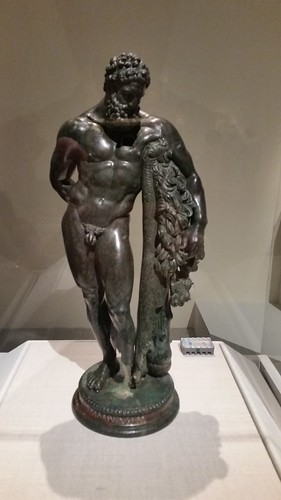
The above is a fragment containing what might be the oldest bits of Homer that we have. The words are from the Odyssey, and was featured at the Metropolitan Museum of Art's Pergamon exhibit. Below is a bust believed to represent Homer.


Click on Herakles for few more images from that exhibit:


Pergamon MET 2016.06

Sunday, June 14, 2015

Dreams of Ulysses


 By happenstance Jutta heard this piece on the radio while reading up on Inferno 26, the canto of Ulysses. It's a piece for viola by John Woolrich entitled Ulysses Awakes, based upon an aria from Monteverdi's Il Ritorno d'Ulisse in Patria, performed by Maxim Rysanov.

With our reading and this piece, we have an Homeric figure that has been transformed by Dante, set to music by Monteverdi, and beautifully recomposed by a contemporary British composer. 

Wednesday, March 11, 2015

νήπιος: Philoctetes and Polyphemus

Sometimes looking at a work from another angle brings a renewed appreciation for something one thought had already been sufficiently savored.

Having recently read Daniel B. Levine's close study of the resonances in Sophocles' Philoctetes of the encounter of Odysseus and the Cyclops in Odyssey 9, I've been thinking about the relation of the play to the epic scene, and while I still think there's more to it than I have fathomed, it's already enriching elements of the play in ways I'd not have imagined.

Take for example the scene (already discussed here) in which Philoctetes makes his first entrance. Before he's even on the stage, the wounded man is rumbling, crashing, making noises, not articulate sounds. If we superimpose this scene upon Homer's, we note that Polyphemus arrives with his own crash:
           φέρε δ᾽ ὄβριμον ἄχθοςὕλης ἀζαλέης, ἵνα οἱ ποτιδόρπιον εἴη,ἔντοσθεν δ᾽ ἄντροιο βαλὼν ὀρυμαγδὸν ἔθηκεν:
He bore a mighty weight of dry wood to serve him at supper time, [235] and flung it down with a crash inside the cave.
The only reason Odysseus has stayed in the cave is to see whether the cave's inhabitant was capable of hospitality -- i.e., a civilized being, not a monster -- and now he knows.

Sophocles sets up his scene beautifully to draw us in -- the island setting is just like island settings in the Odyssey where marvels occurred, and we are there. Only here, the crashing sounds of Philoctetes are made by his jagged walking -- he sounds monstrous, and as he approaches the chorus says:


His cries are loud, and terrible. (217)


But when the unknown being appears, he's very much like a man.

The chorus is grappling with the same question Odysseus had: human or inhuman? As the scene unfolds, we get Philoctetes' first view, or actually, his first hearing, of the sailors. And with a beautiful symmetry, Sophocles depicts this creature -- who but a moment before seemed a monster -- to swoon with delight to hear well-spoken Greek:


O cherished sound!

The tongue reveals to him, before anything is even said, that these are men like him, and to them that he is a well-spoken man, a Greek like them. If we think of our underlying Homeric scene, this happy recognition of similars is precisely what is missing in the Cyclops' cave:


“So he spoke, and in our breasts our spirit was broken 
for terror of his deep voice and monstrous self;"

Before Polyphemus establishes that the only place Odysseus and his men will go is down his gullet, his voice, though speaking Greek, makes it clear that he is no man who honors guests, suppliants, and gods:
he straightway made answer with pitiless heart: ‘A fool (νήπιος) art thou, stranger, or art come from afar, seeing that thou biddest me either to fear or to shun the gods. [275] For the Cyclopes reck not of Zeus, who bears the aegis, nor of the blessed gods, since verily we are better far than they. Nor would I, to shun the wrath of Zeus, spare either thee or thy comrades, unless my own heart should bid me.
Only a νήπιος would assume that humanity is everywhere alike. νήπιος in fact means incapable of speech -- exactly like infans in Latin. To be νήπιος is to fail to see difference, unlikeness -- here, it's the failure to see that one is looking at a monster.

Odysseus now has the answer to his question: alas, it's the bone-crunching end to all questing. The mouth of the Cyclops produces no cherished sound, but opens to use his guests with engulfing savage power.

One effect, then, of the parallel with Homer's scene is to highlight a difference that lies, unquestionably, in the mouth. Philoctetes sounds like a monster but delights in hearing the tongue of Greeks. The scene brightens through its difference with that of the Cyclops, but a dark cloud lies within: the potential heartless, godless, monstrous use of a man that lurks through the scenes that follow.

Friday, June 27, 2014

A tourist arrives in Ithaka

Since we're thinking about Homer's epics in connection with Heroides I, it was good to find a brief note in sententiae antiquae (Bons mots from ancient Greek and Roman authors) that brings us back to the Odyssey.

We are reminded that Odysseus arrives in his native land in Book 13 -- the center of the poem. It will take him all 12 remaining books to fully arrive, as himself, to the peace at the center of his home.

Upon waking, he has no idea where he is, or that he is, in fact, on Ithaka. sententiae notes the reversal that comes with his first encounter:
mournfully longing for his native land, [220] he paced by the shore of the loud-sounding sea, uttering many a moan. And Athena drew near him in the form of a young man, a herdsman of sheep, one most delicate, as are the sons of princes.
He is in a mist, a spell from Athena. Everything, including the goddess, seems strange, but isn't.
In a double fold about her shoulders she wore a well-wrought cloak, [225] and beneath her shining feet she had sandals, and in her hands a spear. Then Odysseus was glad at sight of her, and came to meet her, and he spoke, and addressed her with winged words: “Friend, since thou art the first to whom I have come in this land, hail to thee, and mayst thou meet me with no evil mind. [230] Nay, save this treasure, and save me; for to thee do I pray, as to a god, and am come to thy dear knees. And tell me this also truly, that I may know full well. What land, what people is this? What men dwell here? Is it some clear-seen island, or a shore [235] of the deep-soiled mainland that lies resting on the sea?”
Athena playfully plays the tourism official, speaking to the king of Ithaka as if he were a hopeless dimwit from some dark land:
Then the goddess, flashing-eyed Athena, answered him: “A fool art thou, stranger, or art come from far, if indeed thou askest of this land. Surely it is no wise so nameless, but full many know it, [240] both all those who dwell toward the dawn and the sun, and all those that are behind toward the murky darkness. It is a rugged isle, not fit for driving horses, yet it is not utterly poor, though it be but narrow. Therein grows corn beyond measure, and the wine-grape as well, [245] and the rain never fails it, nor the rich dew. It is a good land for pasturing goats and kine; there are trees of every sort, and in it also pools for watering that fail not the year through. Therefore, stranger, the name of Ithaka has reached even to the land of Troy which, they say, is far from this land of Achaea.”
Did you ever notice how local newspapers that publish on the Internet rarely indicate what state they are located in? They're the "Ithaca Times," or the "Star Herald," no need to say New York, or Maine, because of course everyone who reads that paper knows where they are. Storytellers are always at the omphalos, the center of "the" world.

It's wonderful how Homer brings Odysseus home the moment he finishes telling the tale of his voyages to "mighty Alcinous." He'd brought his Phaeacian listeners around the world to places strange, far off, and marvelous. Now, waking from the deep sleep in which he was borne home, he is that listener, utterly ignorant, unable to recognize his homeland.

The journey to full recognition - by his nurse, his dog, his son, his swineherd, his enemies, his father, and finally his wife - becomes the second half of his odyssey. It builds to a perfect pitch during the inquest (or close reading) he is subjected to by Penelope in Book 23:
. . . she went down from the upper chamber, and much her heart pondered whether she should stand aloof and question her dear husband, or whether she should go up to him, and clasp and kiss his head and hands. But when she had come in and had passed over the stone threshold, she sat down opposite Odysseus in the light of the fire [90] beside the further wall; but he was sitting by a tall pillar, looking down, and waiting to see whether his noble wife would say aught to him, when her eyes beheld him. Howbeit she sat long in silence, and amazement came upon her soul; and now with her eyes she would look full upon his face, and now again [95] she would fail to know him, for that he had upon him mean raiment.. . .
Telemachos: “My mother, cruel mother, that hast an unyielding heart, why dost thou thus hold aloof from my father . . .?"

Penelope: “. . . if in very truth he is Odysseus, and has come home, we two shall surely know one another . . ."

 . . . and the much-enduring, goodly Odysseus smiled . . .
We might want to re-read this as we think about Penelope's letter to the man whose identity she will take her time to recognize.

Sunday, June 22, 2014

The textual intimacy of Penelope

Ovid begins his book of love letters with Penelope, writing to her husband whose fate is unknown. As she explains, she heard much of the tale of Troy from her son, Telemachus, who got it from Nestor. She got some information from Menalaos as well. Ovid, then, is grounding his poem in Homer -- the news of the war that is the Iliad, and fragments of the fate of Ulysses after Troy fell, which set the scene in the early books of the Odyssey.

So Penelope's letter is full of references to the two epics, and we could do worse than refresh our memory of some of the key characters and scenes that she mentions, as here:
And he told of Rhesus and Dolon dead by your sword,
so that one was betrayed by sleep, the other by guile.
It was brave, oh you, who are more and more forgetful of your own,
to enter the Thracian camp, with night’s deception,
and kill so many men, with the help of one!
Then you were truly cautious, and thinking first of me!
My heart shook all the time, with fear, while my dear hero
was depicted, riding through the army on Ismarus’s horses.
Dolon
The tale of Rhesus and Dolon (known as the Doloneia) takes place in book 10 of the Iliad, and concerns a night raid that Diomedes and Odysseus carry out. They capture and interrogate Dolon, a  Trojan spy (dressed as a wolf), then use his information to kill Rhesus, a rich king newly arrived to the war. It's a terrific episode of guile, Odyssean quick wittedness, and double-dealing. Apart from its value in the epic, we might think about why Penelope includes it in her letter.

Penelope also mentions minor characters, like Tlepolemos, a son of Herakles who dies at the hands of Sarpedon, and Antilochus, the youngest son of Nestor, whose best known feat, dying to save his father's life, isn't in the Iliad, but is remembered in Pindar's 6th Pythian:
Long ago, too, powerful Antilochus showed that he had this way of thinking; [30] he died for his father's sake, by awaiting the man-slaying commander of the Ethiopians, Memnon. For the horse kept Nestor's chariot from moving, since it had been wounded by Paris' arrows; and Memnon was aiming his strong spear. [35] The old man of Messene, his mind reeling, shouted to his son; the cry he hurled did not fall to the ground; his god-like son stayed on the spot and paid for his father's rescue with his own life, [40] and because he accomplished this tremendous deed he seemed to the younger men to be the greatest man of his time in excellence towards his parents.
It seems that Penelope was acquainted with the fates of characters even Homer doesn't include in his narrative!

Also, Penelope's letter is not celebrating the heroic life, as Pindar does in his Odes. If anything, as she weaves her web alone, far from the action, she speaks as the end term, the destination, of Ulysses. She is what was there before he left to help take Helen back, and she'll be there to hear the stories upon his return. But is she simply an auditor, waiting for the heroic song to arrive?

Thursday, June 19, 2014

The core of coeur-age

The first Olympian sets the scene for Pelops' address to Poseidon:


near to the gray sea, alone in the darkness, 
he called aloud on the deep-roaring god, 
skilled with the trident; and the god 
appeared to him, close at hand.

Pelops then says:


Since all must die, why should anyone nameless 
sit in the dark, foolishly stewing old age 
with no share in all that is good? As for me, on this contest 
I will take my stand.

Compare Sarpedon's speech that comes near the center of the Iliad (end of Book Twelve):

'Glaukos, why is it you and I are honored before others
with pride of place, the choice meats and the filled wine-cups
in Lykia, and all men look on us as if we were immortals,
and we are appointed a great piece of land by the banks of Xanthos,
good land, orchard and vineyard, and ploughland for the planting of wheat?
 
Therefore it is our duty in the forefront of the Lykians
to take our stand and bear our part of the blazing of battle,
so that a man of the close-armoured Lykians may say of us,
“Indeed these are no ignoble men who are lords of Lykia,
these kings of ours, who feed upon the fat sheep appointed
and drink the exquisite sweet wine, since indeed there is strength
of valour in them, since they fight in the forefront of the Lykians.”
 
'Man, supposing you and I, escaping this battle,
would be able to live on forever, ageless, immortal,
so neither would I myself go on fighting in the foremost
nor would I urge you into the fighting where men win glory.
But now, seeing that the spirits of death stand close about us
in their thousands, no man can turn aside nor escape them,
let us go on and win glory for ourselves, or yield it to others.'


Wednesday, June 30, 2010

To Mercury


An old translation by John Conington, 1882:

Grandson of Atlas, wise of tongue,
O Mercury, whose wit could tame
Man's savage youth by power of song
And plastic game!


Thee sing I, herald of the sky,
Who gav'st the lyre its music sweet,
Hiding whate'er might please thine eye
In frolic cheat.


See, threatening thee, poor guileless child,
Apollo claims, in angry tone,
His cattle;—all at once he smiled,
His quiver gone.


Strong in thy guidance, Hector's sire
Escaped the Atridae, pass'd between
Thessalian tents and warders' fire,
Of all unseen,


Thou lay'st unspotted souls to rest;
Thy golden rod pale spectres know;
Blest power! by all thy brethren blest,
Above, below!


Two translations of the Homeric Hymn to Hermes: Evelyn-White, and here.

Saturday, April 03, 2010

The New Yorker reads Mason, Malouf and Banville

Mussy notes this New Yorker piece, in which Daniel Mendelsohn reviews three recent fictions working with classical Greek materials: John Banville’s “The Infinities,” David Malouf’s “Ransom,” Zachary Mason’s “The Lost Books of the Odyssey."


Among Mendelsohn's fine observations noted:
The first adjective in the first line of the twelve thousand one hundred and nine that make up the Odyssey is polytropos, which means, in the context, “clever”—literally, “of many turns.” Both are apt modifiers for the poem’s hero, who is subject to many detours and is also Greek myth’s preëminent talker, fibber, and plotter. If the Iliad, set during a war, keeps showing us men’s bodies, either in frenzied action or stilled by death, the Odyssey, set in war’s aftermath, can be described as a poem about the mind—a celebration of the intellectual and verbal qualities that we might need to survive in a world uneasily settling back into the forgotten habits of peacetime. And a quality of mind that the Odyssey admires extravagantly is the ability to tell a good story. It’s easy to forget that nearly all the famous adventures we associate with Odysseus—the encounters with the Cyclops, the witch Calypso, Scylla and Charybdis, the Lotus Eaters—are narrated not by the poem’s invisible narrator, the “I” who invokes the Muse in the first line, but by Odysseus, about himself. At a certain point in his voyage, he finds himself on an island inhabited by refined, pleasure-loving natives called the Phaeacians, and, one night over dinner, he tells them the story of his homecoming thus far. This takes up four entire books of Homer’s poem—which is to say that much of the Odyssey is a kind of epic performance within the epic, a long flashback in which the “poet” and the hero are one and the same person.
Which adds resonance to some of the parallels we've noted between Milton's Satan and Odysseus.

Friday, February 19, 2010

Blind poets and prophets

In addition to Thamyris, Milton mentions Homer, Phineas, and Tiresias in his invocation to Book III:

Blind Thamyris and blind Mæonides, [ 35 ]

And Tiresias and Phineus Prophets old.

The common thread is that all were blind. At least three were blinded by the gods as a form of punishment, or limitation. Thamyris, as we've seen, lost his sight for his hubris in challenging the muses.

Phineas
Phineas features in the story of Jason and the Argonauts: [He] was said to be a son of Poseidon, or of Phoenix, and had the gift of prophecy. Zeus, angry that Phineas revealed too much of the plans of the gods, punished him by blinding him and setting him on an island with a buffet of food. However, he could eat none of it because the harpies, vicious, winged women, stole the food out of his hands right before he could eat.[1] This continued until the arrival of Jason and the Argonauts. They sent the winged heroes, the Boreads, after the harpies. They succeeded in driving the monsters away but did not kill them, as a request from the goddess of the rainbow, Iris, who promised that Phineas would not be bothered by the harpies again. It is said that the Boreads were turned back by Iris at the Strophades.[2]As thanks, Phineas told the Argonauts how to pass the Symplegades.

Tiresias
Tiresias was a prophet of Apollo. According to the mythographic compendium Bibliotheke,[3] different stories were told of the cause of his blindness, the most direct being that he was simply blinded by the gods for revealing their secrets. An alternate story told by the poet Pherecydes was followed in Callimachus' poem "The Bathing of Pallas"; in it, Tiresias was blinded by Athena after he stumbled onto her bathing naked.[4] His mother, Chariclo, a nymph of Athena, begged Athena to undo her curse, but the goddess could not; instead, she cleaned his ears,[3] giving him the ability to understand birdsong, thus the gift of augury.

Homer
The poet's name is homophonous with ὅμερος (hómēros), meaning, generally, "hostage" (or "surety"), long understood as "he who accompanies; he who is forced to follow", or, in some dialects, "blind".[19] The assonance itself generated many tales relating the person to the functions of a hostage or of a blind man. In regard to the latter, traditions holding that he was blind may have arisen from the meaning of the word both in Ionic, where the verbal form ὁμηρεύω (homēreúō) has the specialized meaning of "guide the blind",[20] and in the Aeolian dialect of Cyme, where ὅμηρος (hómēros) was synonymous with standard Greek τυφλός (tuphlós), meaning 'blind'.[21]

It should be noted that the names of these famous Greek poets and prophets come after the description of the poet's chief haunt:

Thee Sion and the flowrie Brooks beneath
That wash thy hallowd feet, and warbling flow,

and before the evocation of the nightingale, whose bloody tale has been evoked by Ovid, Dante, Chaucer, Shakespeare, Eliot and many others:


Then feed on thoughts, that voluntarie move

Harmonious numbers; as the wakeful Bird
Sings darkling, and in shadiest Covert hid
Tunes her nocturnal Note.