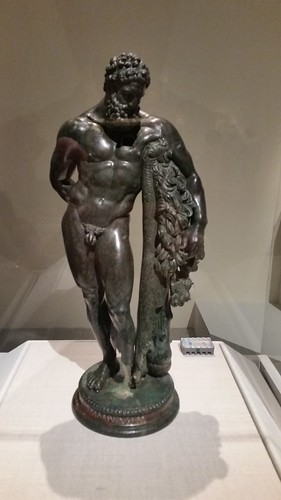
Showing posts with label hercules. Show all posts

Wednesday, July 20, 2016

Pergamon at the Met


The above is a fragment containing what might be the oldest bits of Homer that we have. The words are from the Odyssey, and was featured at the Metropolitan Museum of Art's Pergamon exhibit. Below is a bust believed to represent Homer.


Click on Herakles for few more images from that exhibit:


Pergamon MET 2016.06

Monday, December 08, 2014

Mirroring Centaurs and inverted medicines: Chiron and Nessus

Here's an odd example of unexpected symmetry in The Women of Trachis -- some might say it's a stretch, but bear in mind, the material of the myth was all one giant text to the Greeks.

Deianira is about to relate her discovery -- her dawning apprehension that Nessus gave her no love charm. She tells how she faithfully followed the dying Centaur's every instruction:
I let fall (παρῆκα) no part of the precepts which the savage Centaur gave me when he was hurting from the bitter barb in his side; they were in my memory, like the graven words which no hand may wash from a tablet of bronze.
ἐγὼ γὰρ ὧν ὁ θήρ με Κένταυρος, πονῶν
πλευρὰν πικρᾷ γλωχῖνι, προυδιδάξατο
παρῆκα θεσμῶν οὐδέν, ἀλλ᾽ ἐσῳζόμην
χαλκῆς ὅπως δύσνιπτον ἐκ δέλτου γραφήν.
She is thinking of Nessus as if he were a teacher, not a rapist. She adheres to his formula for making the charm as if it were a medicine she is learning to compound from a learned pharmacist. This of course should remind us of Chiron, the one Centaur who was learned in many arts, including medicine. (Chiron was a giver of the gift of knowledge not unlike Prometheus, only he did not suffer the wrath of Zeus for having stolen sacred fire.)

The irony is that Heracles killed both Nessus and Chiron with the same poisoned weapon -- though in the case of Chiron, it was an accident. At least one well-known tale goes this way:
Chiron had been poisoned with an arrow belonging to Heracles that had been treated with the blood of the Hydra . . . this had taken place during the visit of Heracles to the cave of Pholus on Mount Pelion in Thessaly when he visited his friend during his fourth labour in defeating the Erymanthian Boar. While they were at supper, Heracles asked for some wine to accompany his meal. Pholus, who ate his food raw, was taken aback. He had been given a vessel of sacred wine by Dionysus sometime earlier, to be kept in trust for the rest of the centaurs until the right time for its opening. At Heracles' prompting, Pholus was forced to produce the vessel of sacred wine. The hero, gasping for wine, grabbed it from him and forced it open. Thereupon the vapors of the sacred wine wafted out of the cave and intoxicated the wild centaurs, led by Nessus, who had gathered outside. They attacked the cave with stones and fir trees. Heracles was forced to shoot many arrows (poisoned with the blood of the Hydra) to drive them back. During this assault, Chiron was hit in the thigh by one of the poisoned arrows. (Wikipedia)
The tale continues with Chiron, who was immortal, suffering so greatly that he wished to die. Heracles then brokered an exchange by which the Centaur was permitted to die and Prometheus was freed from his savage punishment.

Heracles, then, killed both the noblest Centaur and the worst of them, and used knowledge gained from Chiron (about the poison) to do it. When Nessus tells Deianira that he can give her a potent charm, he is imitating Chiron's instruction of Heracles. And when he is struck by the Hydra-tainted arrow, he replicates the death of Chiron. Deianira, then, could have been misled by a kind of chiastic mirroring:

Chiron - teacher of Heracles - wounded by Heracles' poisoned arrow:
<> 
:Nessus - mortally wounded by Heracles - teacher of Deianira

The similarities are superficial. Upon closer consideration one might realize that if anyone could have used the Hydra's poison to good purpose, it would have been Chiron, but he couldn't. Chiron gave men medicine to preserve life and knowledge to make the best of it. Nessus, the doppelganger, gives a charm that horribly takes life. And the charm takes the form of a shirt, a copy, or replica, of the human form beneath.

Chiron certainly gave Centaurs an aura of primal learning - an air of authority and respectability which even someone as intelligent as Deianira might mistakenly attribute to all Centaurs.

The balanced structure of the myth would surely have fascinated the Greeks: Heracles was brought up and became who he was thanks to the illumination and humane tutelage of Chiron. And then he was brought down thanks to the prescription of a fraudulent beast who resembled him superficially. That doubleness, the real and the mere copy -- is itself underscored by the reality that Chiron and Nessus are "like" each other precisely in being dual creatures, double natures. And the difference between the dual natures lies precisely in the gift of benign culture -- of teaching, paideia.

We are not far from the Phaedrus's lesson in the differences between true knowing and mere writing. And writing is indeed present in Deianira's account of how she faithfully followed Nessus's precepts:
they were in my memory, like the graven words which no hand may wash from a tablet of bronze.
In a coming post we'll look at the charm itself in the Women of Trachis.

Thursday, November 20, 2014

Rending through rendering: Deianira's caustic tongue

Ovid's letter from Deianira to Hercules (Heroides #9) recounts the standard list of the hero's mighty deeds:
. . . of enormous serpents, throttled and coiling their lengths about your infant hand; how the Tegeaean boar has his lair on cypress-bearing Erymanthus, and afflicts the ground with his vast weight. You do not omit the skulls nailed up in Thracian homes, nor the mares made fat with the flesh of slain men; nor the triple prodigy, Geryones, rich in Iberian cattle, who was one in three; nor Cerberus, branching from one trunk into a three-fold dog, his hair inwoven with the threatening snake; nor the fertile serpent that sprang forth again from the fruitful wound, grown rich from her own hurt; nor him whose mass hung heavy between your left side and left arm as your hand clutched his throat; nor the equestrian array that put ill trust in their feet and dual form, confounded by you on the ridges of Thessaly. (Showalter translation, 85ff).
Only here, the hero, dressed as a slave girl at the feet of Omphale, is the one speaking them . . .


Deianira goes further than the painter to imagine the Lydian nymph in an exchange of Hercules' famed attire:
These deeds can you recount, gaily arrayed in a Sidonian gown? Does not your dress rob from your tongue all utterance? The nymph-daughter of Jardanus has even tricked herself out in your arms, and won famous triumphs from the vanquished hero. Go now, puff up your spirit and recount your brave deeds done; . . .  O shame, that the rough skin stripped from the flanks of the shaggy lion has covered a woman’s delicate side! You are mistaken, and know it not – that spoil is not from the lion, but from you; you are victor over the beast, but she over you. A woman has borne the darts blackened with the venom of Lerna, a woman scarce strong enough to carry the spindle heavy with wool; a woman has taken in her hand the club that overcame wild beasts, and in the mirror gazed upon the armor of her lord!
The queen's scathing image combines moral force with witheringly vivid reflection. The imagined mirror in which Omphale admires herself is designed to burn Heracles' conscience to the ground.

Before he dons the shirt of Nessus, Heracles is already sizzling. Prior to putting on the blood-smeared texta, Ovid finds the poetic equivalent of the Lernaean Hydra's blood in the caustic sarcasm of Deianira's text:


Thursday, October 16, 2014

Deianira and erotic alchemy

Deianira's opening speech in Women of Trachis is a powerfully compressed reminiscence of a married woman in the prime of life. Exiled thanks to her husband's horrific act of violence against Iphitus, she looks back to when as a young girl, already the object of desire by the ancient bull-dragon-River God Achelous, she experienced a nightmarish dread of marriage (and of erotic desire), and a kind of dreamlike salvation through the mighty arms of Heracles.

The surfacing of those early fears leads to ruminations on what it's like to be married to a kind of superman action figure always away, always on call. Heracles is hounded by Hera, exploited by Eurystheus, dominated by Omphale, and about to be destroyed by Deianira, who speaks of her man as the sole guarantor of her and her children's lives and happiness.

Trachis opens at ground level, exposing the roots of men and women, the latent terrors and erotic alchemy that make it possible for a young virgin to be attractive to an ancient shape-shifting god who's the scariest thing imaginable to her; etching as well the status of a woman, a centripetal home-maker (and fertile seedbed) yoked to a potent wandering Punisher who is subject in turn to the inestimable enmity of the most powerful goddess.
ἐγὼ γὰρ ἥμην ἐκπεπληγμένη φόβῳ 
μή μοι τὸ κάλλος ἄλγος ἐξεύροι ποτέ. 
But I was struck with terror,
lest my beauty should win me torment in the end.
Right from the start, Sophocles enmeshes us in a web of opposites that repel and attract. Deianira's word for being "struck" is ἐκπλήσσω:  It carries the sense of being driven out of one's senses by shock, fear, or amazement; panic-struck. It means can also mean: seized with desire, love-struck. 

The opening of Women of Trachis is seething with latent forces, desires, and fears, some of the deepest known to women and to men. Torment and beauty sit at the root of Deianira's and Heracles' world. One might describe such an opening, in short, as over-sexed.

Wednesday, October 15, 2014

A lesson in cross-dressing

Ovid's Fasti contain a host of tales, some rather bawdy. Here's part of the tale (Fasti Book 2) of Faunus, who spied Omphale walking with Hercules and was wounded by love.
By chance Tirynthian Hercules was walking with Omphale,
His mistress, and Faunus saw them from a high ridge.
He saw and burned. ‘Mountain spirits,’ he said,
‘No more of your company: she will be my passion.’
... 
It was midnight. What will unruly love not dare?
Faunus came through the dark to the dewy cave,
And seeing the servants lost in drunken slumber,
Had hopes of their master also being fast asleep.
Entering, as a reckless lover, he roamed around,
Following his cautious outstretched hands.
He reached the couches spread as beds, by touch,
And this first omen of the future was bright.
When he felt the bristling tawny lion-skin,
However, he drew back his hand in terror,
And recoiled, frozen with fear, as a traveller, troubled,
Will draw back his foot on seeing a snake.
Then he touched the soft coverings of the next couch,
And its deceptive feel misled him.
He climbed in, and reclined on the bed’s near side,
And his swollen cock was harder than horn.
But pulling up the lower hem of the tunic,
The legs there were bristling with thick coarse hair.
The Tirynthian hero fiercely repelled another attempt,
And down fell Faunus from the heights of the couch.
At the noise, Omphale called for her servants, and light:
Torches appeared, and events became clear.
Faunus groaned from his heavy fall from the high couch,
And could barely lift his limbs from the hard ground.
Hercules laughed, as did all who saw him lying there,
And the Lydian girl laughed too, at her lover.

 Tintoretto: Hercules expels Faunus from Omphale's bed

Xenocleia's tripod

The stories about Heracles are so various and numerous as to dwarf all other heroes. The tale of Xenocleia, linked to the murder of Iphitos and the mandatory service to Omphale, is worth a look:
Xenoclea, who appears as a character in the legend of Hercules, was the Pythia, or priestess and oracle, of the temple of Apollo at Delphi.
The Delphic oracle was a historical reality and was established in the 8th century BC. 
According to Pausanias and others, Hercules travelled to Delphi to consult the Oracle following the death of Iphitus, whom he had thrown off a wall in the city of Tiryns while Iphitus was staying with him as a guest. Suffering from nightmares, Hercules sought advice as to how to be cured. However, when he came to address his request to Xenoclea, she refused to help him, considering that he was still unpurified from the blood and death of Iphitus and also being shocked by the nature of his crime. Her only answer to him was "You murdered your guest, I have no oracle for such as you".  
This contemptuous reply so enraged Hercules that he sacrilegiously seized the priestess's Delphic tripod, took it away, and would not return it until she had agreed to grant his own request.
After the return of her tripod, and after bathing in the Castalian Spring, Xenoclea pronounced that Hercules would be purified of the death of Iphitus only by serving a year as a slave, with the price he fetched going to the children of Iphitus as compensation for the loss of their father. Asked who was to buy him, Xenoclea replied that it would be Omphale, Queen of Lydia. Hercules accepted the guidance of the oracle and agreed to serve Omphale for one year. 
Ancient depictions of the incident in the temple survive. On one ancient vase, Hercules is shown carrying off the sacred tripod, while Apollo, holding a branch of laurel, struggles to recover it and Xenoclea, apparently terrified by the dispute, looks on from a window, awaiting the outcome.
Heracles is more than the brilliant hero of the labors. He struggles with gods, scares oracles, and destroys innocent humans, including his first wife and children. Yet he was the splendid, saving alternative to Achelous:
Deianira: But at last, to my joy, the glorious son of Zeus and Alcmena came and closed with him in combat and delivered me.

Apollo and Hercules struggling for possession of the tripod, with Artemis on the left helping her brother, and Athena, in the center, helping Hercules.


Monday, October 13, 2014

Hercules in chains - of gold

Ovid offered another perspective on Hercules and Iole in Heroides 9, a letter from Deianira to the hero, with a sly dig - here's Kline's translation:
Now a foreign rival is brought before my eyes,
and I cannot hide from myself what I suffer!
You won’t let me avoid her: she walks like a captive
through the middle of the city to be seen by unwilling eyes.
But not with unbound hair in the manner of a captive:
she confesses her good fortune by her seemly looks,
walking, visible far and wide, covered with gold,
just as you yourself were dressed in Phrygia:
Omphale in Hercules' garb

Saturday, October 11, 2014

Heracles still at work

The BBC brings us yet another Heracles. A show in which the images allegorize the achievements of the Russian strongman.

He grapples with the hydra of Western sanctions:


Here, Putin is destroying the coarse "oligarch beasts":


Here he's riding a Crimean ox that's broken away to return to mother Russia:


The participating artists preferred to remain anonymous. More here: The 12 Labours of... Putin.

[Added]: Happy Birthday Mr. Putin

Tuesday, September 30, 2014

Heracles, Theseus, Achelous, & Deianira in Metamorphoses

A few of the many questions that Ovid's text of Hercules, Achelous, and Theseus provokes for me - no particular order:

Why the careful set-up of the exquisite dinner party in Achelous' grotto - (a setting so intriguing that it was imitated in Renaissance gardens for hundreds of years)?

Ovid also depicted Theseus at the notorious dinner party for the wedding of Pirithous - what does this conjunction suggest?


What is Achelous's relation to his nature as a river?

Asking why water, trees and transformation run deeply throughout the tales told in the grotto, all precedent to the entrance of Heracles in Book 9.

One might notice, though not right away, that the story of Deianira frames all of the tales between the end of the Calydonian Boar hunt in Book 8 and the death (and birth) of Hercules in Book 9. Does this suggest a relation between the Boar (and Hunt) and the strange career of Hercules and Deianira?

Wednesday, September 17, 2014

Ovid's rendering of Heracles

Our next reading will be Sophocles' Women of Trachis, but given our recent involvement with Ovid, the plan is to spend one session on Ovid's treatment of the theme, which mostly falls into Metamorphoses 9.

I've pasted the entire section relating to the river Achelous below the fold, including the tales at the end of book 8, since that is where Theseus, returning from the Calydonian Boar hunt, meets the river, hears his stories, including those about Heracles, before moving on. The text is from here. The blog pertaining to the Metamorphoses is here.