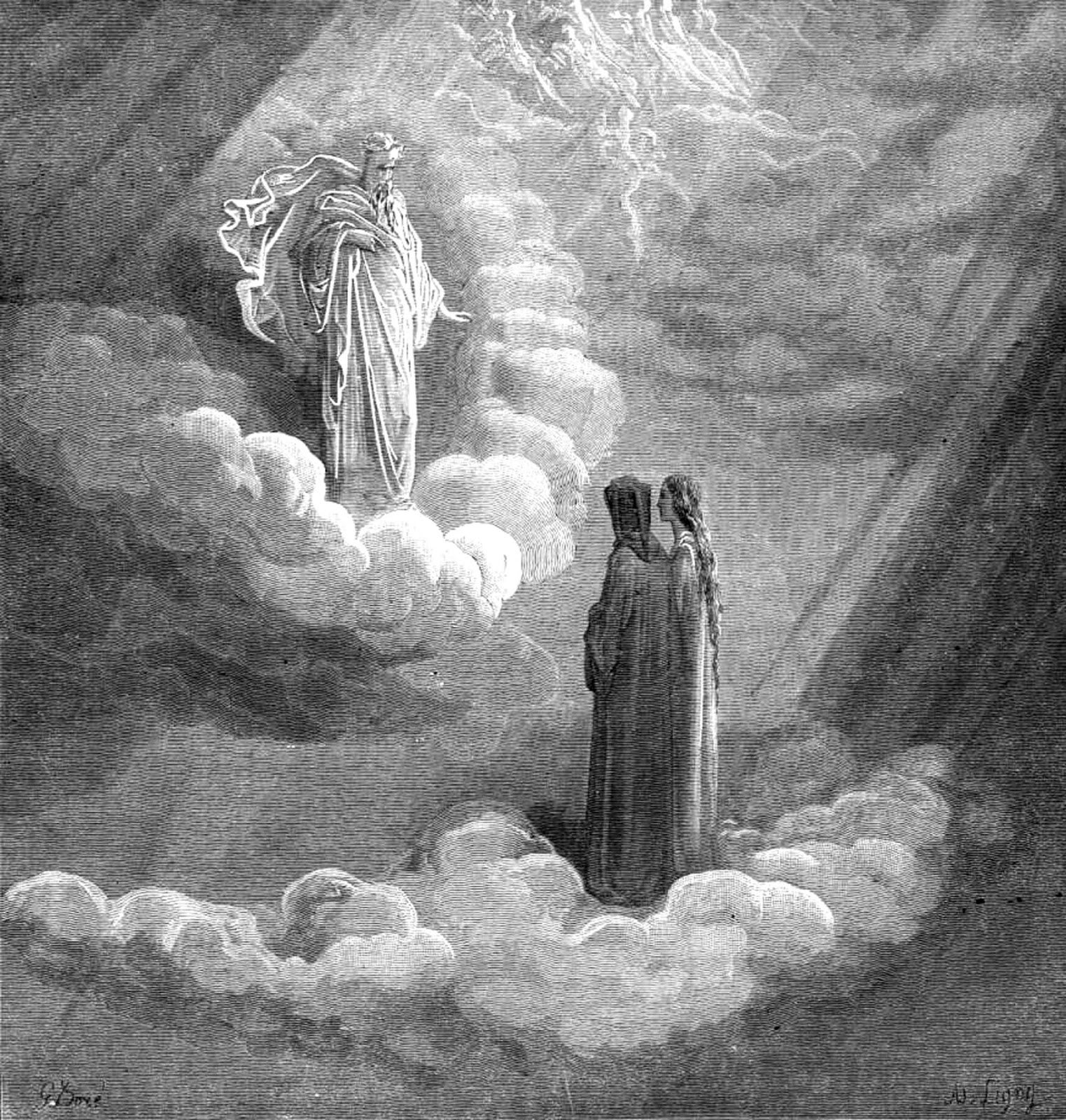
Showing posts with label cacciaguida. Show all posts

Thursday, December 01, 2016

Vision's end: Cacciaguida and the Eagle (Par. 15/19)

Much time and space here was given to Paradiso 18 for two reasons - first, it traces a clear change in the poet's power to speak (and speak truth to power); next, it begins the second half of the Paradiso, and one argument I'll be making is that Dante deliberately wishes us to see Paradiso 17 as a center and a threshold between two different aspects of Paradise.

To see what's happening before and after the center more clearly, it's helpful to note that the cantos on either side of 17 balance each other. For example, 15 and 19, 14 and 20, etc. each have parallel elements, creating a kind of nested ring structure around the center. However, Dante's "rings" have torque -- the differences between cantos 15 and 19 (or 14 and 20) are deeply germane to an expansion or transformation occurring through the canticle. An architectonic whose rings turn to something more.

An example or two might help. 

We can see this "symmetry with a difference" in cantos 15 and 19 as an example. Each stands two cantos removed from 17. In 15, Cacciaguida appears before Dante and tells him "I am your root." Between the two is established an organic connection -- the ties of family, of Firenze, of culture and history connect them like root and branch of a single tree. In canto 18, Cacciaguida's closing speech will note that all of Paradise is a series of sills, or thresholds (soglia) of a tree that "lives from the top":
dell'albero che vive della cima
e frutta sempre e mai no perde foglia
 of the tree which lives from the top
and is always in fruit and never sheds its leaves. (18:29-30)
The organic tree of life rooted in earth, time, and history is replaced by this tree, that clearly stands outside of nature. One finds upside down trees, or trees fed from above, in esoteric lore and in the Kabbalah (e.g., the sephirot) and other wisdom traditions.

The encounter with Cacciaguida is rich in warmth, human connection, memory and history, neighborhood gossip and love of city, patria, and God. Canto 15 ends with Cacciaguida detailing the virtues and great citizens of their city:
Saria tenuta allor tal maraviglia
una Cianghella, un Lapo Salterello
qual or saria Cincinnato e Corniglia. 
As great a marvel then would have been held
A Lapo Salterello, a Cianghella,
As Cincinnatus or Cornelia now. (15:127-29)
In Canto 19, Dante is facing a giant composite of just souls who are subsumed within the image of the head and wings of an eagle. The image stuns the poet when it speaks -- indeed, its speech is unlike any ever recorded, because instead of saying "we," all the voices in unison say "I."

This is the eagle that came from the "M" in canto 18 -- an eagle born of letters. The souls that form it are described as conserte, that is, interwoven. The poet introduces that astonishing description of the plural speaking as "I" -- a grammatical violation of number -- with an echo of Paul's echo of Isaiah:
But as it is written:
“What eye has not seen, and ear has not heard,
and what has not entered the human heart, what God has prepared for those who love him,” (1 Cor. 2.9)
Paul, who was also taken up to Paradise, is saying that nothing our senses have ever offered can prepare us for what awaits us. But it's worth noting that Paul is not saying this, he's citing Isaiah 64.4. Dante is introducing this giant segno, this eagle that has nothing to do with natural birds, via a text citing a text citing a text.

The eagle speaks with authority about the limitations of human vision and intellect. The entire canto is steeped in words for seeing, the eye, the ocean floor that the eye cannot penetrate. What the eagle does say is that the limit to our vision is what enables us to discern that its origin is far beyond all that it can see. Thanks to this very limit, or failure, human vision (veduta) "sees" that its origin must derive from something unseen and unseeable.
Dunque vostra veduta, che convene
 essere alcun de' raggi de la mente
 di che tutte le cose son ripiene,
non pò da sua natura esser possente
 tanto, che suo principio non discerna
 molto di là da quel che l'è parvente.


In consequence our vision, which perforce
  Must be some ray of that intelligence
  With which all things whatever are replete, 
Cannot in its own nature be so potent,
  That it shall not its origin discern
  Far beyond that which is apparent to it.  (19:52-57)
The double negative form of the statement suggests that the very thing that the poet and many of his fellow humans view as a frustrating obstacle to our wish to see and know is not so powerful as to blind us to this truth of our origin. If our vision were greater, we might fail to see how far we are from our actual root. The evidence of our senses, in its paucity, proves that we begin beyond the senses. (One hears intimations of immortality here found in other writers -- Descartes and Wordsworth, for example.)

The turning around of the canticle began in Paradiso 17 with the appearance of writing, which is itself re-presenting Scripture. The Eagle is a profoundly rich image that, yes, is linked with the symbol of Rome and empire, but, like Homer's "winged words," it is also the sign of signification itself, rooted precisely not in sensory mimesis.

That the figure of a natural creature known for having the sharpest sight demonstrates the limits of our vision makes for the comic irony here. First we learn that our powers of seeing are limited, and we are shown that this tells us something important about us. The eagle-eyed speaker then goes on, not unlike Cacciaguida did with Florentines, to look at a series of kings.

We can see the parallels here - the figure Dante is speaking with is reviewing actual personages of history. But the differences are equally telling:
  • Cacciaguida described the modest citizens of Florence past, the virtuous city. The Eagle speaks at a higher level of power, and about larger aggregates of people - it speaks of kings, the heads of nation states.
  • Cacciaguida speaks of fellow citizens - people of his own background, some from his own experience. The Eagle speaks of rulers of far flung nations, which it has the eyes to see, but we do not. In fact, though, the eagle is not seeing them at all. It's reading about them in a volume filled with the infamies of these kings. As commentators note, this is scripture depicted in the Apocalypse (20:12) that records the foul deeds of the damned. Hence the irony - the Eagle is not "seeing" these figures, but reading about them in a book that, though it appears at the end of days, in fact already contains all the deeds and horrors of human history. 
  • Cacciaguida is recounting people of the past; the Eagle is reading of events which had not yet occurred in 1300.
Indeed, two entirely different kinds of seeing and memory are at work here. Cacciaguida speaks from his life, his memories. Though a series of tercets begins with the word for seeing, the Eagle speaks from its reading, and the tercets that list the kings are replete with references to writing:
Che poran dir li Perse a' vostri regi,
 come vedranno quel volume aperto
 nel qual si scrivon 
tutti suoi dispregi? 
Lì si vedrà, tra l'opere d'Alberto,
 quella che tosto moverà la penna, 
What to your kings may not the Persians say,
When they that volume opened shall behold
In which are written down all their dispraises?

There shall be seen, among the deeds of Albert,
That which ere long shall set the pen in motion, (19:112-116)
If Cacciaguida praised and criticized his fellow citizens and then went forth on Crusade to the Holy Land, the Eagle is looking out at a time when the kings of Europe will shame their lands before the non-Christian peoples. The perspective has radically shifted with the substitution of written records for lived experience.

Note the repeated use of segnare:
Vedrassi al Ciotto di Ierusalemme
segnata con un i la sua bontate,
quando 'l contrario segnerà un emme.
Be seen the Cripple of Jerusalem,
  His goodness represented by an I,
  While the reverse an M shall represent; (19:127-129)
Frederick's contribution to the hall of shame qualifies him for lettere mozze -- mutilated letters (134), abbreviations.

Writing of course is a vast abbreviation, based on signs we learn in order to record what is no longer visible or in any other way available to the senses. When the plenitude of the sensory realm is subsumed into a sign; when a word or missive can fly from hither to yon, and speak of what no longer is, or of what is not yet, one is in a different modality from mimesis, from representation.

We can look at more implications of this point in Paradiso where vision and knowledge end, and nations have heads without sense or vision. Whatever else, what comes to the fore must be the irrepressible modalities of faith and hope.

Friday, November 11, 2016

Candid Raptor: The Poet as Ganymede in Par. 18

To briefly review: Paradiso 18 begins with the poet hesitant, uncertain, seemingly adrift in the echoing world of words and ambivalent symbols that mirror and point, obstruct and paralyze. He needs a guide but a guide as beautiful as Beatrice threatens to content him right where he is.

Beatrice points him away from herself - he sees the fervid face of Cacciaguida and hears a roll call of heroes before being carried upward to Jupiter. As this transition occurs, he finds the eyes of Beatrice again:
e vidi le sue luci tanto mere,
tanto gioconde, che la sua sembianza
vinceva li altri e l'ultimo solere.
 And so translucent I beheld her eyes,
  So full of pleasure, that her countenance
  Surpassed its other and its latest wont.  (18:55-57)
Among other things, this is a subtle reminder that Jupiter is the jovial planet, the temperate silver sphere. We've left the fiery passion of Mars behind, and will encounter the cold meditative realm of Saturn ahead. The expansion experienced in the next tercet's simile is an expansion of mind, heart, and ethical awareness:
E come, per sentir più dilettanza
 bene operando, l'uom di giorno in giorno
 s'accorge che la sua virtute avanza,

sì m'accors' io che 'l mio girare intorno
 col cielo insieme avea cresciuto l'arco,
 veggendo quel miracol più addorno.
 And as, by feeling greater delectation,
  A man in doing good from day to day
  Becomes aware his virtue is increasing,

So I became aware that my gyration
  With heaven together had increased its arc,
  That miracle beholding more adorned.  (18:58-63)
There's a speed, a kind of expanding upward fall, that foreshadows the figure of the eagle and other birds in motion that will resonate in this sphere. But the poet is not flapping arms or imitation wings, like some wannabe Daedalus. This upward gyration (reversal of his ride to lower hell on Geryon) owes itself to another. Something is powering him and Beatrice up and outward -- it is not unreasonable to think here of Ganymede, plucked from Earth by Jove in the form of an eagle, because his beauty seduced the god.

After the poet has construed, or conceived, the letters, words, and figures of M, Lily, and Eagle, he's read the text of Wisdom - an imperative - and it spurs him to a complex apostrophe:
 O dolce stella, quali e quante gemme
 mi dimostraro che nostra giustizia
 effetto sia del ciel che tu ingemme!
O gentle star! what and how many gems
  Did demonstrate to me, that all our justice
  Effect is of that heaven which thou ingemmest! (18:115-117)
The between heaven and our justice on earth is at stake. As the spirits of Jupiter have spelled the words, and as the words are from a mind that has no guide, because it guides all things, so Dante's text, repeating the words spelled out, is speaking not his own mind, nor the spirits' minds, but Mind. (Besides other readers' suggestions such as "monarchia," this "emme" -- the central letter of Dante's alphabet - could also stand for "mente.")

Like the pure eyes of Beatrice, the text speaking is not merely Dante's text, but the pure instance of Wisdom :
26 For she is the brightness of eternal light, and the unspotted mirror of God's majesty, and the image of his goodness.

26 candor est enim lucis aeternae et speculum sine macula Dei maiestatis et imago bonitatis illius. (7:26)
The candor of Jupiter is the lucidity of a figure and text that doesn't hide, or mislead, or turn and try to pass itself as a god - for that is folly:
15 For they have esteemed all the idols of the heathens for gods, which neither have the use of eyes to see, nor noses to draw breath, nor ears to hear, nor fingers of hands to handle, and as for their feet, they are slow to walk. 
16 For man made them: and he that borroweth his own breath, fashioned them. For no man can make a god like to himself.
 15 quoniam omnia idola nationum aestimaverunt deos quibus neque oculorum visus est ad videndum neque nares ad percipiendum spiritum neque aures ad audiendum nec digiti manuum ad tractandum sed et pedes eorum pigri ad ambulandum 
16 homo enim fecit illos et qui spiritum mutuatus est is finxit illos nemo enim sibi similem homo poterit deum fingere
Wisdom, among other things, knows the difference between what is truly divine, and what is man-made imitation. Only fools worship idols sans eyes, ears, nose, fingers, or breath. In the joviality of clay feet "slow to walk" is laughter that springs up, uncontrived, when confronted with mortals' folly.

The poet thus has had an encounter with something that is not figural, not mimetic, not idolatrous, but the literal candor of the word. This motion from letters into words that form the parts of speech that form the sentence that speaks Mind is an act of clear reading. Dante's text scrupulously repeats, combines and makes intelligible what was there, which now transforms into the raptor of Jove.

If we try now to "see" what's happened to the poet in this canto, he too has metamorphosed. Like the virtuous man who suddenly feels the dilettanza of his good works, his ambit grows as he reaches a tempered vision of the mind of god. And not just vision, because to see "what God means" is to be summoned in a way that one cannot refuse, a summons which is more like being caught up, rapt from one's own thoughts, one's own life, to act. Like Ezekiel who ate the scrolls, or Jonah, or Isaiah.

The underlying thesis here -- a submerged thread of this series of readings of the Commedia for some time -- is that Dante's poem does more than speak. It acts. The poet here reads what is inscribed against the whiteness of Jupiter and turns to address the source of that inscription:
Wherefore I pray the Mind, in which begin
  Thy motion and thy virtue, to regard
  Whence comes the smoke that vitiates thy rays;

So that a second time it now be wroth
  With buying and with selling in the temple
  Whose walls were built with signs and martyrdoms!

O soldiery of heaven, whom I contemplate,
  Implore for those who are upon the earth
  All gone astray after the bad example!
The poet first addresses Mind, then the milizia del ciel - the power of heaven which he is contemplating as he speaks. Poet and pilgrim - he who saw the soldiery then, and who contemplates it now, are contemporaneous in contemplating Wisdom. In calling upon those he addresses, Dante is reiterating Cacciaguida's roll call on Mars, when to name the heroes of Christendom was to move them to action.

Then the poet turns to the Pope. I'll address that third apostrophe in one last post.

Thursday, October 27, 2016

"Non pur ne'miei occhi": A poet's doubt (Par. 18)


At the very moment in Paradiso 17 that the poet has finished listening to Cacciaguida's foretelling of his future, and immediately preceding the advice the old man will give him about the poem he'll go on to write, we have the image of weaving:
Poi che, tacendo, si mostrò spedita
l'anima santa di metter la trama
in quella tela ch'io le porsi ordita,
When by its silence showed that sainted soul
That it had finished putting in the woof
Into that web which I had given it warped, (17.100-102)
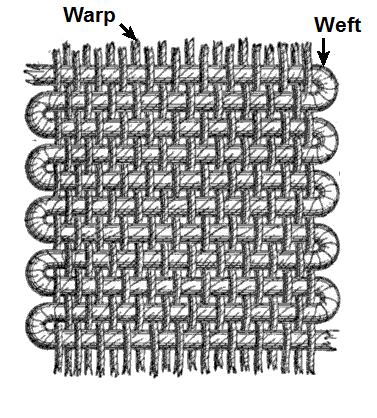
The image is of a tela - a web, or textile, which serves as the metaphor for the text they both are weaving. The poet puts down the warp (ordita), the old man provides the woof, or weft (trama). 
Warp_and_weft.jpg
 Paradiso 17 ends with Cacciaguida's heartfelt encouragement to 
Make manifest thy vision utterly,
  And let them scratch wherever is the itch.
At this key moment of the canticle, we might assume that with these marching orders, the poet needed no further resolve to complete the poem, the very reason he was shown, in fact,
                                within these wheels,
Upon the mount and in the dolorous valley,
Only the souls that unto fame are known.
So it's all the more surprising when, at the opening of the next canto (18) we hear the poet, still on Mars, still tasting his great great grandfather's bittersweet word (verbo), now speak openly of abandoning his task:
Not only that my language I distrust,
  But that my mind cannot return so far
  Above itself, unless another guide it.
non perch' io pur del mio parlar diffidi,
ma per la mente che non può redire
sovra sé tanto, s'altri non la guidi.  (18.10-12)
Not only is Dante, like Theseus, helpless here to find his way back to memory without an Ariadne, he's also diffident about his parlar - his speaking. For one whose mission is to bring back his journey, a guide is on hand -- but for a poet to lack trust in his own speaking, this sounds like a crisis of faith.

To further complicate things, the guide whom he turns to -- "the Lady who to God was leading me" -- mirrors such love and beauty that he is entranced to the point of seduction:
her again beholding, my affection
  From every other longing was released.

While the eternal pleasure, which direct
  Rayed upon Beatrice, from her fair face
  Contented me with its reflected (secondo) aspect,
rimirando lei, lo mio affetto
libero fu da ogne altro disire,

fin che 'l piacere etterno, che diretto
raggiava in Bëatrice, dal bel viso
mi contentava col secondo aspetto.
Beatrice, the guide and symbol whose precise mission is to lead the pilgrim beyond himself, comes perilously close here to turning into the obstacle -- a Siren, Calypso, or Ariadne -- who threatens to waylay the hero, freeing him from desire to go beyond her.

Quite a predicament: a poet whose mastery of his own speech is uncertain; who, even if he felt secure, would yet be unable to remember what to say unless he has a guide; a guide who in this case happens to be so inherently beautiful as almost to blot out anything beyond her luminous self. Indeed, Beatrice verges on the opposite of a translucent symbol, teetering on becoming an end in herself, a Medusa before whom the poet would seize up, speechless, and end his odyssey right here.


This is not at all what canto 17 set us up for. At the same time, despite the clear details that would render some poets entirely aphasic -- the segmented self lacking confidence in his ability to be at one with speech and memory, entranced by a secondo who's so perfect her smile could persuade us she's the primo -- the text does not exhibit anything like the shattering doubt and anxiety found in Inferno 9, when the Furies called on Medusa to end the poet's progress then and there, once and for all.

All the threats a poet might fear are in play here, but Beatrice is no Siren. Instead of holding him captive, she directs Dante to look away from the very thing he just said he could not do without -- herself:
Conquering me with the radiance of a smile,
  She said to me, "Turn thee about and listen;
  Not in mine eyes alone is Paradise." 
Vincendo me col lume d'un sorriso,
ella mi disse: “Volgiti e ascolta;
ché non pur ne' miei occhi è paradiso.”
Non pur ne'miei occhi, says Beatrice. "Not in my eyes alone." If the poet were not who he is, we might hear him say, "Not a problem - you're paradisal enough for me."

Beatrice's direction is the opposite of what Virgil instructed him to do before Dis:
"Turn thyself round [i.e., away from Medusa], and keep thine eyes close shut," 
“Volgiti 'n dietro e tien lo viso chiuso;"
Here in Paradise, as Beatrice directed, he turns away from her, and sees Cacciaguida do something unprecedented in the poem: The old man speaks a name, and the hero so named shoots across the radius of the giant cross on the red planet. Words assume power, speech and act are one. 
né mi fu noto il dir prima che 'l fatto.

nor noted I the word before the deed.
For a poet struggling with his own power over his art, this would be a powerful thing to witness. The poet's last word about Cacciaguida -- who is singing, his face lit up with his soul's fervor -- is "artista."

The poet is openly coming to grips with the challenges to his power over his medium. Now that he's been given the warp and weft of his place in history, his future, and his mission as artist, it's as if he needs more than ever to make sure that he, as poet, can finish the job. He needs confidence, guidance, faith, and courage. In another post we'll see how the rest of canto 18 speaks to these literally literary matters.

Saturday, October 15, 2016

Triangulating pilgrim and poet: Cacciaguida's manifesto

Paradiso 17 has a centrality that makes itself apparent on several registers. It's the literal center of the canticle, and it's also a moment when, through dialog with Cacciaguida, the poet recapitulates the journey he has taken, and confronts his "root." That radice turns out to be the source of the pilgrim's historical existence as well as the figure that articulates the poem's rhetorical mode. 

The journey of the pilgrim is recapped at least three times in the canto. The first is here:
mentre ch'io era a Virgilio congiunto
 su per lo monte che l'anime cura
 e discendendo nel mondo defunto,
 
dette mi fuor di mia vita futura
 parole gravi,         (17:19-23)
While I was with Virgilius conjoined
Upon the mountain that the souls doth heal,
And when descending into the dead world,
 
Were spoken to me of my future life
Some grievous words; 
 

This reconnoitering -- a looking back to the selva oscura and Cacciaguida's looking back to his life in Florence -- brings the pilgrim and the poet into a kind of convergence. It might not be "random" that Dante's first words to his ancestor in this canto had to do with how triangles cannot have two obtuse angles (17:15), for here Poet and Pilgrim, in conversation with Cacciaguida, undergo a kind of triangulated turn as Cacciaguida explains why this pilgrim's story has to be told through the faces, voices, and fates of people known to fame:
Then [he] made reply: "A conscience overcast 
Or with its own or with another's shame, 
Will taste forsooth the tartness of thy word; 
But ne'ertheless, all falsehood [menzogna] laid aside, 
Make manifest thy vision utterly, 
And let them scratch wherever is the itch; 
For if thine utterance shall offensive be 
At the first taste, a vital nutriment 
'Twill leave thereafter, when it is digested. 
This cry of thine shall do as doth the wind, 
Which smiteth most the most exalted summits, 
And that is no slight argument of honour. 
Therefore are shown to thee within these wheels, 
Upon the mount and in the dolorous valley, 
Only the souls that unto fame are known; 
Because the spirit of the hearer rests not, 
Nor doth confirm its faith by an example 
Which has the root of it unknown and hidden,
Or other reason that is not apparent." 17:124-142
To "make manifest" is to display by action the nature of a thing. To speak of his experience in a way that can be understood by those who hear his poem, the poet must offer the sort of example whose root (radice) is not hidden. This is spoken by the figure who calls himself "your root." Cacciaguida is at the base of a family tree that, planted in Florence, grew through time until it put forth a fronda -- a leaf or branch -- named "Dante." 

The appearance of the root of Dante puts Dante in his place, as a specific human in historical time. It comes shortly before Dante will be displaced, exiled from his city -- a foreknowledge that the pilgrim also gains from this encounter.

For the poem to be read and understood, says Cacciaguida, it must speak of public figures, some of whom were still alive, or recently deceased (like Pope Boniface) even as it was composed. Although the poet is concerned that writing about certain people could have real consequences -- as some of these folks had power to make him unwelcome throughout Italy -- Dante understands that his poem will fail unless his readers see and hear these historical characters.

In other words, the poet has to speak of figures like Francesca, Farinata, Cavalcante, Ugolino, Manfred, La Pia, Charles Martel, and so many others as if they were not poetic figures, which in fact is exactly what they are. 

We might look at it this way: if I tell you that you can believe something I tell you because so-and-so told it to me, and you know him, you might well be persuaded. But now, suppose you learn that I made up the tale of meeting so and so, and his telling me such and such, because that was the only way I could get you to believe me? 

Cacciaguida's manifesto marks the pilgrim's encounters with actual famed personages as the lie necessary to the poem's rhetorical power -- a power which depends upon a reciprocally empowering relation of pilgrim and poet that is also also mutually exclusive. 

Poet and Pilgrim are inextricably bound together - neither can exist without the other, yet each exists only by means of a sacrificial obliteration of the other. This impossible double figure, this mutually annihilating "author," turns out to be the necessary lie fecund enough, as root, to produce this poem. Looked at another way, the poem is rooted in an illogical act of courage that puts forth something that ought by all "knowledge" never to have been possible.

The path of the journey, in this light, must be reconnoitered, and so must be the mode of its speaking. No longer is the story of meeting x, then, y, simply reflected or re-presented by the poem. Rather the truth intent of the poem requires that the poet create and use these figures as if he had extracted them as examples (per essempro*) from his experiences. 

Representation here is usurped by another poetic order: 
"Because the spirit of the hearer rests not,
Nor doth confirm its faith by an example
Which has the root of it unknown and hidden,
Or other reason that is not apparent."
"che l'animo di quel ch'ode, non posa
né ferma fede per essempro ch'aia
la sua radice incognita e ascosa,
né per altro argomento che non paia.”
Instead of the poem being read as the realistic reflection of the pilgrim's experience, that "experience" is revealed as device -- the poet's rhetorical tool necessitated by, and geared to, the mode of the Commedia, which can be called allegory.

The pilgrim and the poet, no longer separable, converge in Cacciaguida's manifesto. Only, we have to be quite clear: Like Cacciaguida's smile, the poem's persuasive power as representation requires it to conceal its poetic strategy. To persuade, it must seem to represent the pilgrim's encounters with famed historical figures as historical narrative, and to conceal the menzogna that it is not poetic artifice, which at every moment it most certainly is. 

Pilgrim and poet fuse here, but they do so precisely as does a triangle with two obtuse angles. The fusion occurs at a point outside the system of the text -- the system which it alone brought into being. The "point" is made in Cacciaguida's dark, luminous manifesto of the rhetorical model -- the courageous speech act -- of the Commedia itself. 


*The root sense of essempro is traced to an act of drawing something forth - i.e., we "make an example" because an example is not just a passive reflection, but an act of rhetorical persuasion.


Saturday, October 08, 2016

This old man and "la gente folle"

We've been asking for a while why it is that at the midpoint of the Paradiso, when we ought to be ascending to the Empyrean, Dante brings us down to earth to listen to an old man who spends three cantos evoking the good (and not so good) old days. 

Of course, it's not any old man.

Paradiso 17 is both the center of the highest canticle and the climax of the pilgrim's encounter with Cacciaguida. Whatever else we might say interpretively, it's clear than Dante has presented us with a vivid, lively character, a fully rendered human being. He is, of course, a man of many parts -- polutropos, as Homer might have said.

Cacciaguida beams with love and joy at meeting his great-great grandson. He has the suppleness of many languages at his disposal, retains a strong memory of his life in Florence, and expresses his love for that earlier moment in its history. He possesses providential vision (as do all whose gaze reaches the cospetto eterno), and, with chivalric precision, seizes the culminating moment of their encounter to en-coeur-age his "leaf." 

The text in which Cacciaguida appears does more than offer a memorable human portrait. Canto 17 opens with the scene of Phaeton seeking to know his old man. One can be told the Sun is one's father, but one wants proof. Seeking to control the horses of the Sun, however, proves to be an apocalyptically bad idea. To the ancient world, nothing was more difficult to know in clear, uncertain terms than one's origin. 

Similarly the tale of Hippolytus and Theseus brings to the fore how difficult it is for a father to know his horseman son* -- even a father who could thread the Minoan labyrinth. Genetic relations are dangerous, treacherous, and difficult to read. Visit the Sun, you're still in the dark -- the ways of the world are ambiguous, indirect -- ambage, as the poet will say.** Natura oscura.

The encounter with Cacciaguida, though, marks a rupture that seems to lead out of this predicament. The full impact of this meeting's place in the heavens becomes clear when we gather that here, on Mars, among the warriors, Dante as pilgrim and poet is reoriented to a point outside the natural order:

                                     il punto  
a cui tutti li tempi son presenti; (17:17-18)

This point, beyond the natural world, sees all contingency before it can occur, and is in fact a reliable source of intelligence about all origination. In learning of his family, his home, and his life through the triangulated gaze of Cacciaguida, Dante is acceding to a source beyond the Sun.
Né per ambage, in che la gente folle
già s'inviscava pria che fosse anciso
l'Agnel di Dio che le peccata tolle,

ma per chiare parole e con preciso
latin rispuose quello amor paterno,
chiuso e parvente del suo proprio riso:
Not in vague phrase, in which the foolish folk 
Ensnared themselves of old, ere yet was slain 
The Lamb of God who taketh sins away, 
But with clear words and unambiguous 
Language responded that paternal love, 
Hid and revealed by its own proper smile: (17:31-36)

La gente folle -- that is, all who lived before the slaughter of the Agnel -- is a potent critique of the world of Virgil and David, Plato and Moses. And it's spoken here not by Cacciaguida or Beatrice, but by Dante. The pathos of the ancients in the first circle of hell, living eternally in desire without hope, is recalibrated here in this new light. The poem is moving yet again into a new phase.

In the next post, we'll see a little of what that new phase entails. One thing is for sure: Dante, as a poet whose poem does what it says, will not leave Cacciaguida until he comes to grips with himself as pilgrim and his mission as poet. The union - or fusion - of pilgrim and poet can be realized, but only in mutual sacrifice. 

What is remarkable here is how Dante grounds even this moment of moving beyond Nature firmly in the world of men. Cacciaguida is no demi-god. No supernatural figures or forces are acting here. There is the word of a sacrificial lamb that broke the ancient model of the gente folle, and a plain-talking old man who guides Dante on his hunt.


*Hippolytus and Phaeton can be seen as classical prefigurations, or analogues, of Corso and Buondelmonte.

**The word ambage appears only here in the Commedia. Hollander's note on the word (l. 31) is helpful - this is the first half of it.
The word ambage has an interesting history. Dante probably found its most troubling presence in Aeneid VI.99, where ambages was used to typify the animal-like sounds of the cave-dwelling Sibyl's prognostications. On the other hand, and as Pio Rajna (“Arturi regis ambages pulcerrimae,” Studi Danteschi 1 [1902]: 91-99) has pointed out, in Virgil, Ovid, and Statius it is also used to describe the twisting path found in the Cretan labyrinth; it also in Virgil indicates an enigmatic way of speaking. 
The etymology reflects this:


Tuesday, June 14, 2016

The fall of chivalry: Paradiso 17

This will just be a brief suggestion, rather than a reading. The Paradiso, the city of God, spends more than three cantos at its dead center on the city of man. 

That city is riven by two kinds of love:
Benigna volontade in che si liqua
sempre l'amor che drittamente spira,
come cupidità fa ne la iniqua,


A will benign, in which reveals itself
Ever the love that righteously inspires,
As in the iniquitous, cupidity, (Par.15. 1-3)
The good love does something noble right at the start -- it falls silent:
silenzio puose a quella dolce lira,
The knights and armies moving along the four equal arms of the cross extinguish their songs in order to listen to this one soul who's arrived, a bit dazzled by the vast red sphere, the gleaming galaxy of the huge cross, the power of music he is moved by without understanding. 

This giving of attention is a constitutive chivalric act. It is the turn from the needs of the self (cupidità) to the other. That tens of thousands of knights and soldiers fall silent at once is  a signal gesture of the knight's honor, service, and love to one in need. It puts the entire Cacciaguida section under the sign of knightly courtesy, which carries a rich and highly sophisticated ethical discipline. (For a sampling of the range and depth of the chivalric paideia, see Aldo Scaglione's Knights at Court, especially chapter 2.)

If we read Paradiso 16 in this light, it might provide an incisive moral perspective. For what we see is a city that is divided -- Cacciaguida gives us the simple honest families of a modest town; the town grows, rich families from outside move in, bringing with them their aristocratic presumptions even as other families are developing mediated systems of lending that will bring untold wealth to their children.

It's a city marred by a failure of Church and State to work in harmony -- perhaps that ideal was only reached in the Knight, he who placed his mastery of power and skill into the service of his lord, and of his lord's Lord.

Perhaps this is why, when Dante first speaks to his great-great grandfather, Beatrice's smile brings an allusion to the story of Lancelot. Unlike Francesca, who met a literary knight in a Romance, the poet meets one who, though found only here in his poem, is presented as not a literary figure, but as an actual knight who served his Emperor and his God. 

And perhaps this is why the central antagonism of Cacciaguida's survey of Florentine development is the suicidal conflict between families of honor and good will on one hand, and on the other, those whose specialization lay in mooching off the church, or, "the insolent breed that plays the dragon behind him that flees and is mild as a lamb to him that shows his teeth," (Par.16.115-117).

At the heart of this civic ruin is the ruined virtue of the heart -- the honorable city of benign will is succumbing to those whose strength lies in clever merchandising and wealth built by greed. 

In this light, the unhorsings of Buondelmonte and of Corso are not two disparate events in a random development. Rather, the ends of these well-heeled deserters of their ladies are two manifestations of the same event: the fall of Florentine cavalleria.

Cacciaguida's portrait of contingent, mortal Florence is both loving and scathing; Dante's "root" speaks openly and clearly of his past and future, and the outcome is literally en-coeuraging -- he steels the poet with what it takes to complete his poem, whatever the risks.
                    . . . all falsehood laid aside,
Make manifest thy vision utterly,
And let them scratch wherever is the itch;

                   . . . rimossa ogne menzogna,
tutta tua visïon fa manifesta;
e lascia pur grattar dov' è la rogna.  (17.127-29)
When we reach this moment near the end of the central canto of the Paradiso, the necessity of this "detour" begins to become clear. The poem could not come to be without this radical injection of boldness and heart. The courage to speak the truth is the only medicine to cure a sick city:
Ché se la voce tua sarà molesta
nel primo gusto, vital nodrimento
lascerà poi, quando sarà digesta.


For if thine utterance shall offensive be
At the first taste, a vital nutriment
'Twill leave thereafter, when it is digested. (17.130-132)
Cacciaguida compared Dante with Hippolytus, who is Ovid's key transitional figure between Pythagoras and Aesculapius. The tale of the journey of the serpent-god from Greece to Rome is the last journey, and the last good story, of the Metamorphoses. It's all told in disguise; Hippolytus himself is disguised, he's now known as "Virbius."

If Ovid wrote of the metamorphosis of Greece into Rome (it might be his central theme), Dante here, inspired by Cacciaguida, dispenses with oracles and the promises of hidden gods. The root is the truth of his life -- to be voiced with chivalric mastery -- openly, freely, boldly,
"Because the spirit of the hearer rests not,

Nor doth confirm its faith by an example
Which has the root of it unknown and hidden
Or other reason that does not appear."
"che l'animo di quel ch'ode, non posa

né ferma fede per essempro ch'aia
la sua radice incognita e ascosa,
né per altro argomento che non paia.”

Thursday, June 09, 2016

Death in Florence - Paradiso 16

The history of Florence before and after Dante is so rich and fraught with conflicts, treacheries and a wide cast of players as to make it hard to keep even the general outlines clear. 

A helpful (and well written) summary can be found in the first chapter of R.W.B. Lewis's Dante: A Lifepublished years ago in the New York Times (the text might be marred by some coding, but it's worth it)

Lewis's chapter is here, and begins with Cacciaguida:
As you walk across the Ponte Vecchio in Florence today, you come upon a plaque bearing a passage from Dante's Divine Comedy. The lines are spoken by Dante's ancestor Cacciaguida, whom the poet encounters in one of the higher spheres of heaven, among the warrior saints. They reflect grimly on an event that took place on that very spot in 1216, almost fifty years before Dante's birth, and plunged the city into decades of turmoil. The event was the murder of Buondelmonte dei Buondelmonti . . . more . . ..
We last encountered Buondelmonte lying dead at the feet of "the mutilated stone that guards the bridge" - the ancient statue of Mars. Cacciaguida's depiction of early Florence climaxes in the tale of the failed attempt to unite two feuding families, the Amidei and the Donati, through marriage. An alliance with the daughter of the Amidei would have forged a bond of common interest between them. All Buondelmonte had to do was to accept the daughter and dowry offered. Instead he chose another bride from the wealthier Donati. 

Remembering an earlier time, Cacciaguida spoke of dowries before they had transformed brides into commodities:
Non faceva, nascendo, ancor paura
la figlia al padre, ché 'l tempo e la dote
non fuggien quinci e quindi la misura.


Not yet the daughter at her birth struck fear
Into the father, for the time and dower
Did not o'errun this side or that the measure.
 
(Par. 15.103-05)
As a direct result of his open betrayal of his troth, Buondelmonte was struck as he came from his wedding. He was knocked from his horse, then stabbed to death in front of his new bride. 

Some nine decades later, the city is ruled and roiled by the irrepressible Corso Donati, fomenting faction at every turn.

In Paradiso 17, Dante will learn of his own exile, of "how hard is the way going down and up another man's stairs." The key figure behind his exile and expropriation was Corso, a relation through Dante's marriage to Gemma Donati, and the swashbuckling head of the black Guelfs, who opposed the Whites, headed by the Cerchi.

Corso married the daughter of a wealthy Ghibelline, which enraged many who had supported him. Eventually the citizens forced Corso to flee the city; he was soon captured nearby. While being led back to Florence, Corso fell or threw himself from his horse, whereupon a captor lanced him to death.


Death of Corso Donati
Dante must have pondered the striking resemblances between the fates of these two men. Both Buondelmonte and Corso chose wealthy brides, not modest maids. Their choices unhorsed them. In Cacciaguida's story, Florence itself had once been a modest maid, but now is festooned with jewelry, make-up, and dress. And the old man compares Dante to Hippolytus, exiled from his native city by a lie, dragged to his death by frightened horses.  (Dante turns out to be less Euripides' tragic Hippolytus than Ovid's, who returns from Hades to live a new life in Italy.)

Buondelmonte's death at the bridge divided the city into the factions which then first were called Guelfs and Ghibellines. Corso's death ended the contention between the city's Whites and Blacks. In both cases, Florentine blood was spilled by Florentines. 

The fates of these two men, almost a century apart, are uncannily alike -- almost as if one fate. They are root and branch of the same "seed plot." It's like an opera or Greek myth, not devised by literary artifice, but given by the history of Florence. From the same plot, but a different seed, Dante will be cut off from his city, but not from his "root." He'll complete his solar journey thanks to the clear oracles of Cacciaguida. 

Tuesday, May 31, 2016

A Murder in Florence - Paradiso 16

I've been wrestling with Mario's question of two weeks ago: Why, he asked, does Dante put this long, historically detailed image of Florence at the center of the Paradiso?

As I understood his question, the strangeness is not the inclusion of this material, but rather its placement. Why at this moment in the journey, when one would think that mind, heart and soul would be reaching a point of ardor, turning to a sublime apprehension that will eclipse the Earth, let alone one city?


Florence is Dante's patria -- the body politic, the seed plot of the poet's broken earthly life. For some reason, he now has to turn and look close up at it with Cacciaguida, the radice, root of his life. Why?

It's a rich portrait, with much to ponder. Dante tells a story that has remarkable elements. Florence begins imagined as a modest young woman, and after the catalog of famous families, the tale culminates in the tale of the betrayal of a modest young woman. 

Why does Dante make the murder of Buondelmonti the climactic moment of his narrative? Here's the tale as told in a chronicle attributed appropriately enough to a "pseudo Brunetto Latini":
In the year 1216, when Messer Currado Orlandi was podestà, Messer Mazzingo Tegrimi of the family Mazzinghi had himself knighted at a place called Campi, some six miles from Florence, and invited there all the best people [tutta la buona gente] of the town. 
When all the knights had sat down to meat, a buffoon snatched away the full plate set before Messer Uberto dell’Infangati, who was paired at table with Messer Buondelmonte de’ Buondelmonti. This angered Messer Uberto greatly, and Messer Oddo Arrighi de’ Fifanti, a man of valor, roughly reproved him on this account. In reply Messer Uberto told him he lied in his throat, at which Messer Arrighi tossed a full plate in his face. The whole assembly was in an uproar. When the tables had been removed, Messer Buondelmonte struck Messer Oddo Arrighi with a knife and wounded him severely.

As soon as all the company had returned to their homes, Messer Oddo Arrighi took counsel with his friends and relatives, among whom were the counts of Gangalandi, the Uberti, the Lamberti and the Amidei. Their advice was that peace should be concluded over the matter, as a sign of which Messer Buondelmonte should take for wife the daughter of Messer Lambertuccio de’ Amidei, who lived at the head of the bridge. The bride-to-be was the niece of Messer Oddo Arrighi. Accordingly the marriage contract was drawn up and the peace arranged; on the following day the wedding was to be celebrated.

Then Madonna Gualdrada, wife of Messer Forese Donati, sent secretly for Messer Buondelmonte and when he came spoke to him as follows: “Knight, you are forever disgraced by taking a wife out of fear of the Uberti and the Fifanti; leave her you have taken and take this other [i.e. her own daughter] and your honor as knight will be restored.” 
As soon as he had heard, he resolved to do as he was told without taking counsel with any of his kin. And when on the following day, the morning of Thursday February 11, the guests of both parties had assembled, Messer Buondelmonte passed through the gate of Santa Maria and went to pledge his troth with the girl of the Donati family, and left the Amidei girl waiting at the church door.

This insult enraged Messer Oddo Arrighi greatly and he held a meeting with all his friends and relatives in the church of Santa Maria sopra Porta. When all were assembled he complained in strong terms of the disgrace put upon him by Messer Buondelmonte. Some counseled that Buondelmonte be given a beating, others that he be wounded in the face. At this spoke up Messer Mosca de’ Lamberti: “Whoever beats or wounds him, let him first see that his own grave has been dug; a thing done has its own head [cosa fatta capo ha].” They then decided that the vendetta was to be carried out at the very place where the injury had been done, when the parties had gathered for the exchange of the marriage vows.

Murder of Buondelmonte
 And so it came about that on Easter morning, with his bride at his side, Messer Buondelmonte came riding over the bridge in a doublet of silk and mantle, with a wreath around his brow. No sooner had he arrived at the statue of Mars [at Ponte Vecchio], than Messer Schiatta degli Uberti rushed upon him and, striking him on the crown with his mace, brought him to earth. At once Messer Oddo Arrighi was on top of him and opened his veins with a knife. And having killed him, they fled. 
The ambush had occurred at the houses of Amidei, who lived at the head of the bridge. Immediately there was a tremendous tumult. The body of the murdered man was placed on a bier, and the bride took her seat next to him, holding his head in her lap and weeping aloud. In this manner the procession moved through all Florence. And on this day, for the first time, new names were heard, those of the Guelf party and the Ghibelline party.

From a Cronaca attributed to a "pseudo Brunetto Latini": Ferdinand Schevill, Medieval and Renaissance Florence (1961), pp. 106-107 
 Mosca and Dante exchange words in Inferno 28. 
See also this this account and here's another telling, by Thomas Adolphus Trollope.